


 Catalog of Fishes
 literature references
 FishBase
 Bold Systems
 IUCN Red List
 GBIF
GBIF
 NCBI GenBank
Myliobatis tobijei
Bleeker, 1854
Japanese eagle ray
Classification: Elasmobranchii Myliobatiformes Myliobatidae
Reference of the original description
Faunae ichthyologicae japonicae. Species Novae. Natuurkundig Tijdschrift voor Nederlandsch Indië, 6, 395–426
Faunae ichthyologicae japonicae. Species Novae. Natuurkundig Tijdschrift voor Nederlandsch Indië, 6, 395–426
Image of the original description
No image in first description.
No image in first description.
Synonyms / new combinations and misspellings
Aetobatis tobijei, Aetobatus tobijei, Holorhinus tobijei, Mobula tobijei, Myliobatis cornuta, Myliobatis cornutus, Myliobatis tobijaei, Myliobatis tobije
Aetobatis tobijei, Aetobatus tobijei, Holorhinus tobijei, Mobula tobijei, Myliobatis cornuta, Myliobatis cornutus, Myliobatis tobijaei, Myliobatis tobije
Description :
Citation: Myliobatis tobijei Bleeker, 1854: In: Database of modern sharks, rays and chimaeras, www.shark-references.com, World Wide Web electronic publication, Version 05/2024
Please send your images of "Myliobatis tobijei" to info@shark-references.com
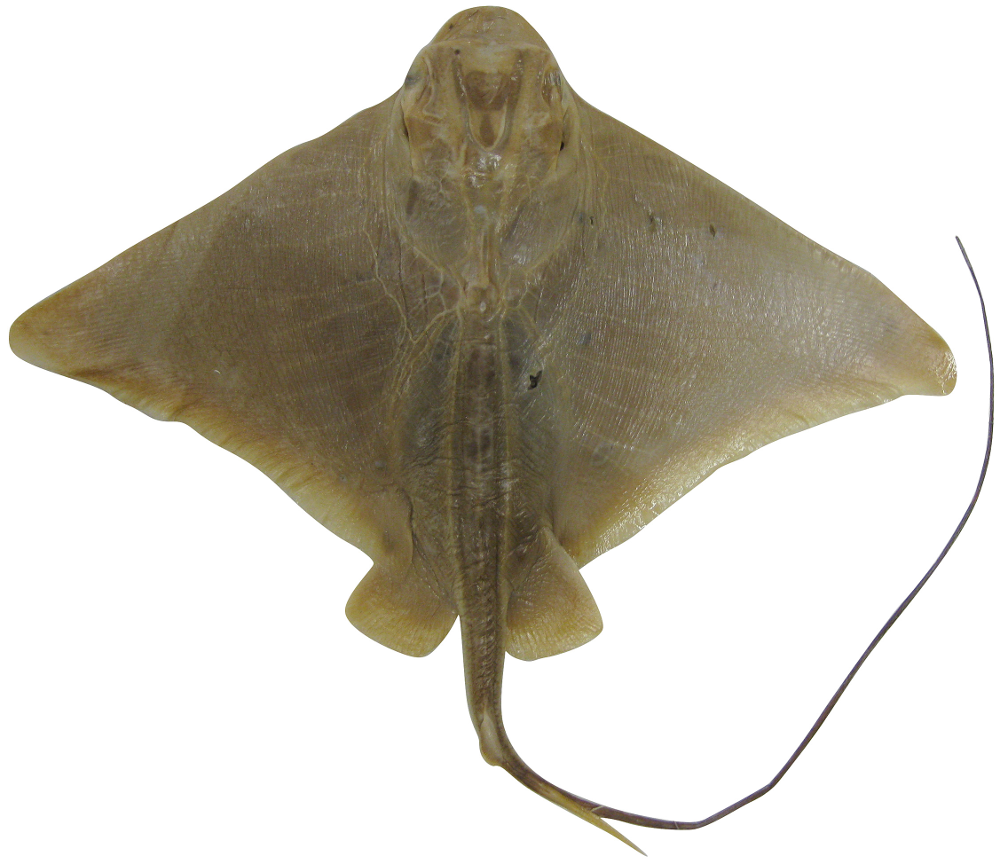
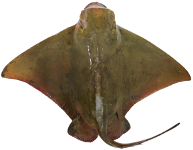
Dorsal view of the holotype of Myliobatis tobijei (RMNH 7461 [largest of 2], juvenile female 236 mm DW, preserved) from Nagasaki, Japan. In: White, W.T. & Kawauchi, J. & CORRIGAN, S. & ROCHEL, E. & Naylor, G.J.P. (2015): Redescription of the eagle rays Myliobatis hamlyni Ogilby, 1911 and M. tobijei Bleeker, 1854 (Myliobatiformes: Myliobatidae) from the East Indo-West Pacific. Zootaxa, 3948 (3): 521–548
Dorsal view of the holotype of Myliobatis tobijei (RMNH 7461 [largest of 2], juvenile female 236 mm DW, preserved) from Nagasaki, Japan. In: White, W.T. & Kawauchi, J. & CORRIGAN, S. & ROCHEL, E. & Naylor, G.J.P. (2015): Redescription of the eagle rays Myliobatis hamlyni Ogilby, 1911 and M. tobijei Bleeker, 1854 (Myliobatiformes: Myliobatidae) from the East Indo-West Pacific. Zootaxa, 3948 (3): 521–548
Common names
 Cowhead eagle ray, Eagle ray, Japanese eagle ray, Kite ray
Cowhead eagle ray, Eagle ray, Japanese eagle ray, Kite ray
Short Description
Diagnose after WHITE, KAWAUCHI, CORRIGAN, ROCHEL & NAYLOR, [22508]: A small Myliobatis (attaining about 665 mm DW) with the following combination of characters: dorsal surfaces yellowish brown, usually with variable, irregular dark blotches; tail with a very weak ventral skin fold; stinging spine(s) relatively long (longest spine 10.3–18.6% DW); interorbital space shallowly concave in adult males; anterior margins of pectoral fins moderately convex; cranial fontanelle (visible in dorsal view without dissection) relatively narrow with mostly straight lateral margins; claspers of adult males 6.6–10.2% DW; predorsal length 66.6–78.8% DW; pectoral-fin radials 79–85 (excluding rostral propterygial radials anterior of eyes); total vertebral centra (including synarcual) 115–124; males mature by 429 mm DW.
Diagnose after WHITE, KAWAUCHI, CORRIGAN, ROCHEL & NAYLOR, [22508]: A small Myliobatis (attaining about 665 mm DW) with the following combination of characters: dorsal surfaces yellowish brown, usually with variable, irregular dark blotches; tail with a very weak ventral skin fold; stinging spine(s) relatively long (longest spine 10.3–18.6% DW); interorbital space shallowly concave in adult males; anterior margins of pectoral fins moderately convex; cranial fontanelle (visible in dorsal view without dissection) relatively narrow with mostly straight lateral margins; claspers of adult males 6.6–10.2% DW; predorsal length 66.6–78.8% DW; pectoral-fin radials 79–85 (excluding rostral propterygial radials anterior of eyes); total vertebral centra (including synarcual) 115–124; males mature by 429 mm DW.
Distribution
Found in the western North Pacific (Sea of Okhotsk; widely distributed throughout mostly southern Japan; in South Korea, recorded from off Busan and Jeju Island) [22508] Source: www.gbif.org
Found in the western North Pacific (Sea of Okhotsk; widely distributed throughout mostly southern Japan; in South Korea, recorded from off Busan and Jeju Island) [22508] Source: www.gbif.org
Human uses
fisheries: minor commercial; price category: medium; price reliability: very questionable: based on ex-vessel price for species in this family
fisheries: minor commercial; price category: medium; price reliability: very questionable: based on ex-vessel price for species in this family
Biology
Exhibit ovoviparity (aplacental viviparity), with embryos feeding initially on yolk, then receiving additional nourishment from the mother by indirect absorption of uterine fluid enriched with mucus, fat or protein through specialised structures [733]. Found from the intertidal to the uppermost continental slope. Lives on the sandy areas in the rocky regions of the Japanese and the East China seas [17641]. Also inhabits coral reefs (Ref. 58534). A carnivore feeding on benthic animals [17641].
Exhibit ovoviparity (aplacental viviparity), with embryos feeding initially on yolk, then receiving additional nourishment from the mother by indirect absorption of uterine fluid enriched with mucus, fat or protein through specialised structures [733]. Found from the intertidal to the uppermost continental slope. Lives on the sandy areas in the rocky regions of the Japanese and the East China seas [17641]. Also inhabits coral reefs (Ref. 58534). A carnivore feeding on benthic animals [17641].
Habitat
demersal; marine; occurs mostly in shallow coastal waters to depths of at least 60 m [22508]
demersal; marine; occurs mostly in shallow coastal waters to depths of at least 60 m [22508]
Dentition
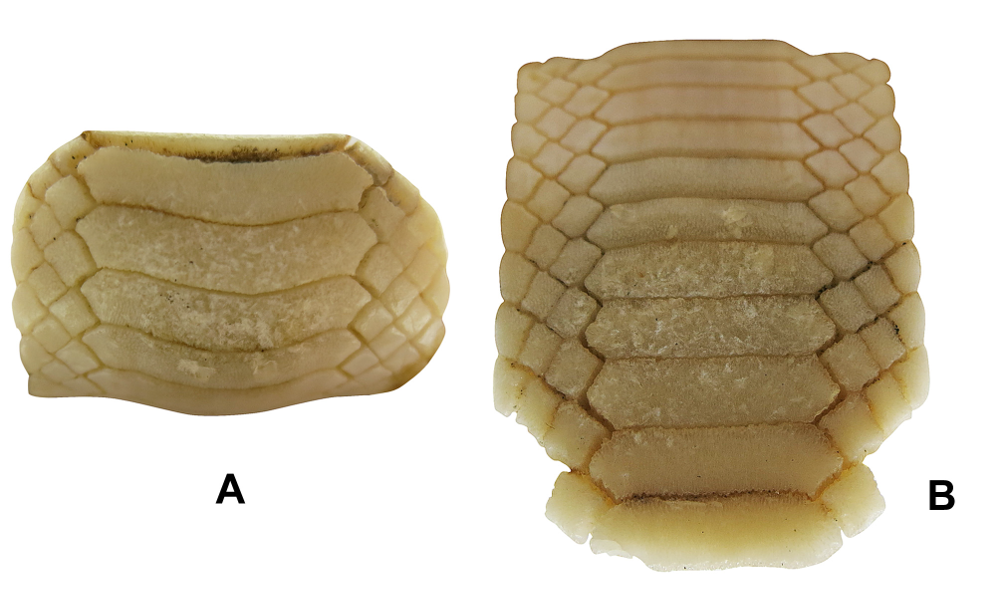
teeth in 7 rows in each jaw, with a broad median row flanked by three smaller rows on each side [22508]
teeth in 7 rows in each jaw, with a broad median row flanked by three smaller rows on each side [22508]
Remarks
shark-references Species-ID=4004;
shark-references Species-ID=4004;
Parasites (arranged by Jürgen Pollerspöck)
Monogenea
Cestoda
Nematoda
Monogenea
- Dendromonocotyle tsutsumii Kitamura & Ogawa, 2019 [27164]
Cestoda
Nematoda
- Mawsonascaris myliobatum (Yin & Zhang, 1983) [15762]
- Raphidascaroides myliobatum Yin & Zhang, 1983 [21235]
Image gallery