


 Catalog of Fishes
 literature references
 FishBase
 Bold Systems
 IUCN Red List
 GBIF
GBIF
 NCBI GenBank
Alopias pelagicus
Nakamura, 1935
Pelagic thresher
Classification: Elasmobranchii Lamniformes Alopiidae
Reference of the original description
On the two species of the thresher shark from Formosan waters. Memoirs Faculty Science Taihoku Imperial University Formosa, 14(1): 1–6, pls 1–3
On the two species of the thresher shark from Formosan waters. Memoirs Faculty Science Taihoku Imperial University Formosa, 14(1): 1–6, pls 1–3
Synonyms / new combinations and misspellings
Alopias aff. pelagicus, Alopias pelagios
Alopias aff. pelagicus, Alopias pelagios
Types
Alopias pelagicus
Alopias pelagicus
Description :
Citation: Alopias pelagicus Nakamura, 1935: In: Database of modern sharks, rays and chimaeras, www.shark-references.com, World Wide Web electronic publication, Version 10/2026
Please send your images of "Alopias pelagicus" to info@shark-references.com
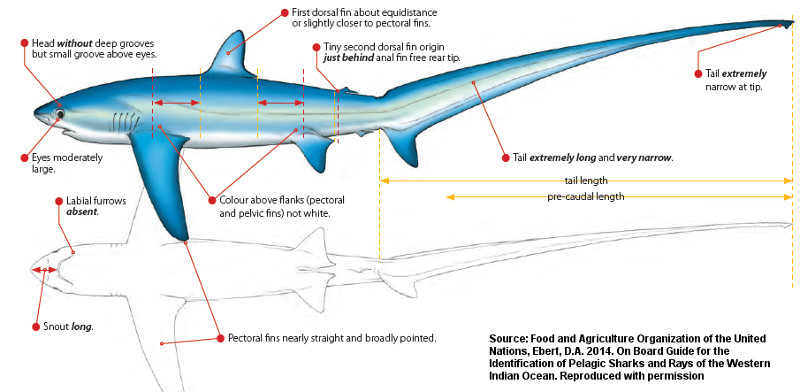
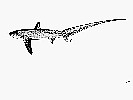
Alopias pelagicus Nakamura, 1935, © FAO, Food and Agriculture Organization of the United Nations, Ebert, D.A. 2014. On Board Guide for the Identification of Pelagic Sharks and Rays of the Western Indian Ocean. Reproduced with permission, illustration by Marc Dando , Wildlife Illustrator
Alopias pelagicus Nakamura, 1935, © FAO, Food and Agriculture Organization of the United Nations, Ebert, D.A. 2014. On Board Guide for the Identification of Pelagic Sharks and Rays of the Western Indian Ocean. Reproduced with permission, illustration by Marc Dando , Wildlife Illustrator
Common names
 Tiburon zorro, Zorro de mar, Zorro pelágico,
  Renard pélagique, Requin-renard,
  Fox shark, Pelagic thresher, Pelagic thresher shark, Small tooth thresher shark, Smalltooth thresher, Smalltooth thresher shark, Thresher shark, Whiptail shark,
  Tubarão-raposo-do-Indico, Zorro pelágico
Tiburon zorro, Zorro de mar, Zorro pelágico, Renard pélagique, Requin-renard, Fox shark, Pelagic thresher, Pelagic thresher shark, Small tooth thresher shark, Smalltooth thresher, Smalltooth thresher shark, Thresher shark, Whiptail shark, Tubarão-raposo-do-Indico, Zorro pelágico
Short Description
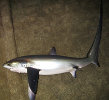
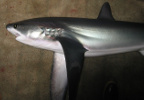
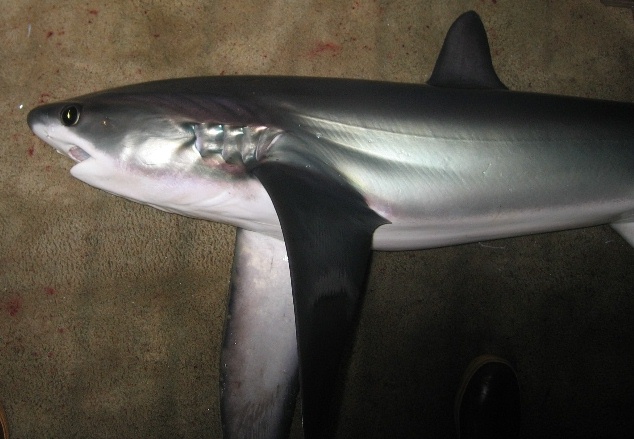
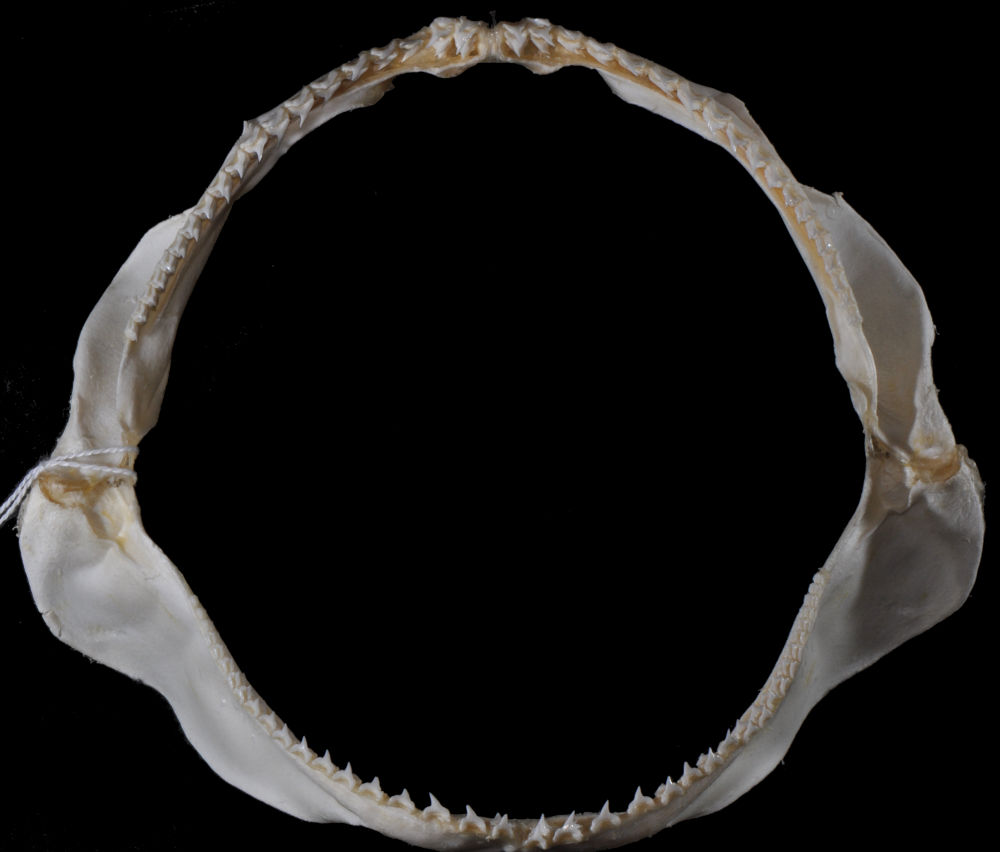
A small thresher with moderately large eyes, a broadly convex forehead, a very narrow caudal tip, and straight, broad-tipped pectoral fins [536]. Upper lobe of caudal fin very long and strap-like, almost equal to length of rest of shark; lower lobe short but strong; terminal lobe very small [20050]. Dark blue on back and sides, underside white; no white patch over pectoral fin bases [536].
Diet: 2013: Ecuadorian waters (data base: 111 speciemens, collected between June and December 2003): Stomach content analysis showed that approximately 77% (n: 85) of stomachs contained prey, of 24 species, including one crustacean, 7 cephalopods, and 16 teleost fishes. According to the %IRI, the three most common components were Dosidicus gigas (66%), Behthosema panamense (30%) and Sthenoteuthis oualanensis (2.9%). The monthly dietary data showed that sharks mainly fed on these three species across all seasons, but the sample sizes were small in some months. Other fish, such as the Pacific sardine Sardinops sagax Jenyns, 1842, hake Merluccius gayi Guichenot, 1848 and squid Loliolopsis diomedeae Hoyle, 1904, were also important prey in some months. [19463]
A small thresher with moderately large eyes, a broadly convex forehead, a very narrow caudal tip, and straight, broad-tipped pectoral fins [536]. Upper lobe of caudal fin very long and strap-like, almost equal to length of rest of shark; lower lobe short but strong; terminal lobe very small [20050]. Dark blue on back and sides, underside white; no white patch over pectoral fin bases [536].
Diet: 2013: Ecuadorian waters (data base: 111 speciemens, collected between June and December 2003): Stomach content analysis showed that approximately 77% (n: 85) of stomachs contained prey, of 24 species, including one crustacean, 7 cephalopods, and 16 teleost fishes. According to the %IRI, the three most common components were Dosidicus gigas (66%), Behthosema panamense (30%) and Sthenoteuthis oualanensis (2.9%). The monthly dietary data showed that sharks mainly fed on these three species across all seasons, but the sample sizes were small in some months. Other fish, such as the Pacific sardine Sardinops sagax Jenyns, 1842, hake Merluccius gayi Guichenot, 1848 and squid Loliolopsis diomedeae Hoyle, 1904, were also important prey in some months. [19463]
Distribution
Circumglobal. Indo-Pacific: Red Sea, Arabian Sea, Maldives [12155], Somalia, South Africa, Western Australia, China, Taiwan, Japan, New Caledonia, Hawaiian Islands and Tahiti. Eastern Pacific: Gulf of California and the Galapagos. Reliable records lacking partly due to its confusion with Alopias vulpinus. Firs record: 2012: Lakshadweep Sea, India (10°52'N latitude 72°13'E longitude) [15389]; 2019: New Ireland Province, Papua New Guinea, western Pacific Ocean [27359] Source: www.gbif.org
Circumglobal. Indo-Pacific: Red Sea, Arabian Sea, Maldives [12155], Somalia, South Africa, Western Australia, China, Taiwan, Japan, New Caledonia, Hawaiian Islands and Tahiti. Eastern Pacific: Gulf of California and the Galapagos. Reliable records lacking partly due to its confusion with Alopias vulpinus. Firs record: 2012: Lakshadweep Sea, India (10°52'N latitude 72°13'E longitude) [15389]; 2019: New Ireland Province, Papua New Guinea, western Pacific Ocean [27359] Source: www.gbif.org
Human uses
fisheries: commercial; gamefish: yes
fisheries: commercial; gamefish: yes
Biology
Exhibit ovoviparity (aplacental viviparity), with embryos feeding on other ova produced by the mother (oophagy) after the yolk sac is absorbed [733] (Ref. 42326). Usually with at least two young [1388]. Size at birth about 100 cm [1388]; 130-160 cm TL [2539]. Distinct pairing with embrace [17086]. A carnivore [17641]. A pelagic species occasionally advancing into coastal waters [17641].
Exhibit ovoviparity (aplacental viviparity), with embryos feeding on other ova produced by the mother (oophagy) after the yolk sac is absorbed [733] (Ref. 42326). Usually with at least two young [1388]. Size at birth about 100 cm [1388]; 130-160 cm TL [2539]. Distinct pairing with embrace [17086]. A carnivore [17641]. A pelagic species occasionally advancing into coastal waters [17641].
Size / Weight / Age
347 cm TL (male/unsexed; (Ref. 48844)); 383 cm TL (female); max. reported age: 29 years (Ref. 48844)
347 cm TL (male/unsexed; (Ref. 48844)); 383 cm TL (female); max. reported age: 29 years (Ref. 48844)
Habitat
pelagic-oceanic; oceanodromous [17660]; marine; depth range 0 - 300 m (Ref. 37816), usually 0 - 150 m (Ref. 55167)
pelagic-oceanic; oceanodromous [17660]; marine; depth range 0 - 300 m (Ref. 37816), usually 0 - 150 m (Ref. 55167)
Remarks
shark-references Species-ID=189; CITES: (see: Protected Species for more details) Convention on International Trade in Endangered Speciesof Wild Fauna and Flora annex: II; Council Regulation 2017/160 annex: B
shark-references Species-ID=189; CITES: (see: Protected Species for more details) Convention on International Trade in Endangered Speciesof Wild Fauna and Flora annex: II; Council Regulation 2017/160 annex: B
Parasites (arranged by Jürgen Pollerspöck)
Cestoda
Trematoda
Nematoda
Acanthocephala
Copepoda
Cestoda
- Heterosphyriocephalus encarnae Dallares, Carrasson & Schaeffner, 2017 [25091] [34640]
- Litobothrium aenigmaticum Caira, Jensen, Waeschenbach & Littlewood, 2014 [21155] [23771] [25740] [34640]
- Litobothrium amplifica (Kurochkin & Slankis, 1973) [7374] [16908] [21155] [23771] [34640]
- Litobothrium daileyi Kurochkin & Slankis, 1973 [16929] [7374] [23771]
- Litobothrium janovyi Olson & Caira, 2001 [21155] [34640]
- Litobothrium nickoli Olson & Caira, 2001 [7374] [21155] [23771] [34640]
- Litobothrium sp. [34640]
- Nybelinia africana Dollfus, 1960 [34640]
- Nybelinia sp. [22562] [16578]
- Scyphophyllidium sp. [34640]
Trematoda
- Elytrophallus mexicanus Manter, 1940 [34640]
- Paronatrema davidbowiei Santoro, Occhibove & Lopez-Verdejo, 2024 [33424] [34640]
- Paronatrema sp. [22678]
- Paronatrema vaginicola Dollfus, 1937 [23771]
Nematoda
- Anisakis sp. [22562] [16578]
- Anisakis typica (Diesing, 1860) Baylis, 1920 [34640]
- Anisakis ziphidarum Paggi, Nascetti, Webb, Mattiucci, Cianchi & Bullini, 1988 [34640]
- Lappetascaris sp. [34640]
- Piscicapillaria sp. [34640]
- Skrjabinisakis brevispiculata (Dollfus, 1966) [34640]
Acanthocephala
- Bolbosoma turbinella (Diesing, 1851) [34640]
Copepoda
- Bariaka alopiae Cressey, 1966 [28156] [34640]
- Dinemoura discrepans Cressey, 1967 [14993]
- Echthrogaleus asiaticus Ho, Liu & Lin, 2012 [21826]
- Echthrogaleus denticulatus Smith, 1873 [16599] [15303] [22562] [16578] [19356] [19355] [25961] [34640]
- Gangliopus pyriformis Gerstaecker, 1854 [34640]
- Nogagus ambiguus Scott, 1907 [22562] [16578]
- Pandarus cranchii Leach, 1819 [25102]
- Pandarus sp. [34640]
Image gallery