


 Catalog of Fishes
 literature references
 FishBase
 Bold Systems
 IUCN Red List
 GBIF
GBIF
 NCBI GenBank
Anoxypristis cuspidata
(Latham, 1794)
Knifetooth sawfish
Classification: Elasmobranchii Rhinopristiformes Pristidae
Reference of the original description
An essay on the various species of Sawfish. Transactions of the Linnean Society of London, 2, 273–282
An essay on the various species of Sawfish. Transactions of the Linnean Society of London, 2, 273–282
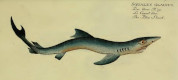
Image of the original description
.jpg)
Anoxypristis cuspidata (Latham, 1794)
Anoxypristis cuspidata (Latham, 1794)
Synonyms / new combinations and misspellings
Anoxypristis cf. cuspidata, Anoxypristis cuspidatus, Oxypristis cuspidatus, Pristis cuspidata, Pristis cuspidatus, Pristis semisagittatus, Pristis (Anoxypristis) cuspidata, Squalus cuspidatus, Squalus semisagittatus
Anoxypristis cf. cuspidata, Anoxypristis cuspidatus, Oxypristis cuspidatus, Pristis cuspidata, Pristis cuspidatus, Pristis semisagittatus, Pristis (Anoxypristis) cuspidata, Squalus cuspidatus, Squalus semisagittatus
Description :
Citation: Anoxypristis cuspidata (Latham, 1794): In: Database of modern sharks, rays and chimaeras, www.shark-references.com, World Wide Web electronic publication, Version 10/2026
Please send your images of "Anoxypristis cuspidata" to info@shark-references.com
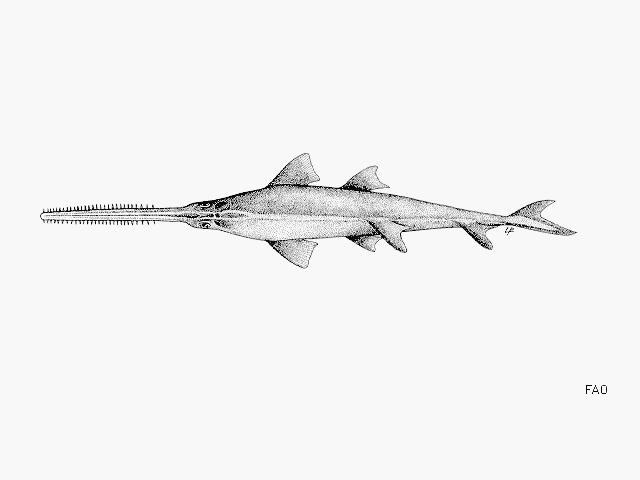
Anoxypristis cuspidata (Latham, 1794), © FAO, www.fish-base.org
Anoxypristis cuspidata (Latham, 1794), © FAO, www.fish-base.org
Common names
 Pez espada,
  Knifetooth sawfish, Narrow sawfish, Pointed saw-fish, Pointed sawfish, Saw fish, Saw shark, Sawfish
Pez espada, Knifetooth sawfish, Narrow sawfish, Pointed saw-fish, Pointed sawfish, Saw fish, Saw shark, Sawfish
Short Description
Greyish above, pale below; fins usually pale. Body shark-like, pectoral fins distinct; head flattened, with a blade-like snout bearing 18-22 pairs of lateral teeth; blade slender, not tapering distally. Nostrils very narrow with small nasal flaps. Rostral teeth short, flattened, broadly triangular, lacking a groove along posterior margins; no teeth on basal quarter of blade. Adults with widely spaced denticles, young with naked skin.
Greyish above, pale below; fins usually pale. Body shark-like, pectoral fins distinct; head flattened, with a blade-like snout bearing 18-22 pairs of lateral teeth; blade slender, not tapering distally. Nostrils very narrow with small nasal flaps. Rostral teeth short, flattened, broadly triangular, lacking a groove along posterior margins; no teeth on basal quarter of blade. Adults with widely spaced denticles, young with naked skin.
Distribution
Indo-West Pacific: Red Sea and the Persian Gulf to New Guinea, north to southern Japan, south to northern Australia [24867]. Source: www.gbif.org
Indo-West Pacific: Red Sea and the Persian Gulf to New Guinea, north to southern Japan, south to northern Australia [24867]. Source: www.gbif.org
Human uses
fisheries: commercial; gamefish: yes
fisheries: commercial; gamefish: yes
Biology
Ovoviviparous. Litter size from 6 to 23, young born in the spring [541]. Inhabits coastal waters and estuaries; probably ascends rivers but its occurrence in freshwater needs to be verified [541]. Common in sheltered bays with sandy bottoms. Feeds on small fish and cuttlefish.
Ovoviviparous. Litter size from 6 to 23, young born in the spring [541]. Inhabits coastal waters and estuaries; probably ascends rivers but its occurrence in freshwater needs to be verified [541]. Common in sheltered bays with sandy bottoms. Feeds on small fish and cuttlefish.
Habitat
benthopelagic; amphidromous [17660]; freshwater; brackish; marine; depth range 0 - 40 m [541], usually ? - 40 m (Ref. 55270)
benthopelagic; amphidromous [17660]; freshwater; brackish; marine; depth range 0 - 40 m [541], usually ? - 40 m (Ref. 55270)
Remarks
shark-references Species-ID=274; CITES: (see: Protected Species for more details) Convention on International Trade in Endangered Speciesof Wild Fauna and Flora annex: I; Council Regulation 2017/160 annex: A
shark-references Species-ID=274; CITES: (see: Protected Species for more details) Convention on International Trade in Endangered Speciesof Wild Fauna and Flora annex: I; Council Regulation 2017/160 annex: A
Parasites (arranged by Jürgen Pollerspöck)
Cestoda
Isopoda
Cestoda
- Floriparicapitus variabilis (Southwell, 1911) [17129] [21566]
- Fossobothrium perplexum Beveridge & Campbell, 2005 [7395] [15747] [17827]
- Pedibothrium globicephalum Linton, 1909 [16410] [16101] [17089]
- Pristiorhynchus palmi Schaeffner & Beveridge, 2013 [17827]
- Proemotobothrium southwelli Beveridge & Campbell, 2001 [16112] [17827]
- Pterobothrium acanthotruncatum Escalante & Carvajal, 1984 [16283] [16112]
- Pterobothrium australiense Campbell & Beveridge, 1996 [16972] [15789]
- Rhabdotobothrium anoxypristidis Coleman & Beveridge & Campbell, 2019 [27352]
Isopoda
- Livoneca ovalis (Say, 1818) [23898]
Image gallery