
Dasyatis margaritella
COMPAGNO & ROBERTS, 1984
Pearl stingray
Classification: Elasmobranchii Myliobatiformes Dasyatidae
Reference of the original description
Marine and freshwater stingrays (Dasyatidae) of West Africa, with description of a new species. Proceedings of the California Academy of Sciences, (Series 4), 43 (18): 283-300, 10 fig.
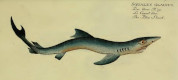
Image of the original description
Image in copyright.
Image in copyright.
Synonyms / new combinations and misspellings
Amphotistius margaritellus, Dasyatis cf. margaritella
Description:
Citation: Dasyatis margaritella COMPAGNO & ROBERTS, 1984: In: Database of modern sharks, rays and chimaeras, www.shark-references.com, World Wide Web electronic publication, Version 05/2013
Common names
Pearl stingray
Pearl stingray
Short Description
Disc oval, moderately flat, its medial lobe broad-based and moderately exserted, its anterior margin concave; middle third of disc covered with small heart-shaped or circular flat denticles, no enlarged thorns on disc or tail; snout moderately long, acutely pointed; pearl spines always present and moderately large (Ref. 26277). Total tooth rows 28-41/34-50; total pectoral radials 113-127 (Ref. 7397). Disc and pelvic fins gray-brown above, without spots or prominent markings, white below and without a marginal dark band (Ref. 26277).
Distribution
Eastern Central Atlantic: off Cap Blanc to Angola. Often confused with Dasyatis margarita (Günther, 1870) (Ref. 7397).
Biology
Exhibit ovoviparity (aplacental viviparity), with embryos feeding initially on yolk, then receiving additional nourishment from the mother by indirect absorption of uterine fluid enriched with mucus, fat or protein through specialised structures [733]. Distinct pairing with embrace [17086].
Size / Weight / Age
30.0 cm TL (male/unsexed; (Ref. 7397)); max. published weight: 1,000 g (Ref. 7397)
Habitat
demersal; brackish; marine
Parasites arranged by Pollerspöck, Jürgen
Cestoda
Cestoda
- Rhinebothrium sp. (host Dasyatis cf. margaritella [16908])