


Paraorthacodus rossi
Cappetta, Morrison & Adnet, 2019
Classification: Elasmobranchii Hexanchiformes Paraorthacodontidae
Reference of the original description
A shark fauna from the Campanian of Hornby Island, British Columbia, Canada: an insight into the diversity of Cretaceous deep-water assemblages. Historical Biology, 33(8), 1121–1182
A shark fauna from the Campanian of Hornby Island, British Columbia, Canada: an insight into the diversity of Cretaceous deep-water assemblages. Historical Biology, 33(8), 1121–1182
Description:
Citation: Paraorthacodus rossi Cappetta, Morrison & Adnet, 2019: In: Database of fossil elasmobranch teeth www.shark-references.com, World Wide Web electronic publication, Version 10/2026
Please send your images of "Paraorthacodus rossi" to info@shark-references.com
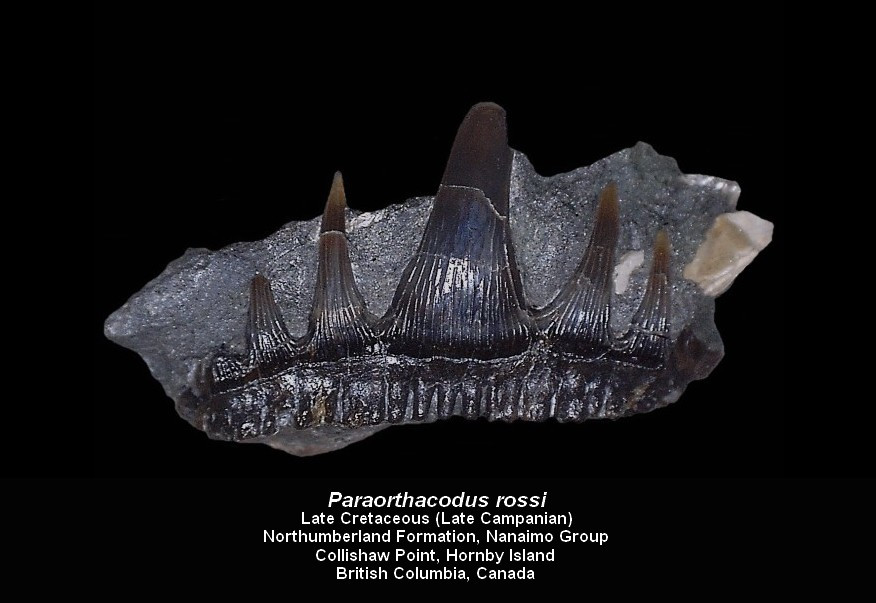
Paraorthacodus rossi Cappetta, Morrison & Adnet, 2019, Late Cretaceous, Late Campanian, Northumberland Formation, Nanalmo Group, Collishaw Point, Hornby Island, Canada, collection and © Adam Anderson
Paraorthacodus rossi Cappetta, Morrison & Adnet, 2019, Late Cretaceous, Late Campanian, Northumberland Formation, Nanalmo Group, Collishaw Point, Hornby Island, Canada, collection and © Adam Anderson
Description
Original diagnosis after Cappetta, Morrison & Adnet, 2019 [27810]: Teeth with high and rather narrow central cusp; high mesial and distal cusplets, with the height of proximal ones about half that of the central cusp; proximal distal and mesial cusplets erect, broadly separated from the central cusp by a deep and broad U-shaped notch. The base of the labial face of the central cusp is narrower than its lingual face this being seen from its base on both sides. In profile view, the cusplets are less bent lingually compared to the central cusp. The lingual and labial faces of the cusp and cusplets are covered by vertical, parallel and closely disposed folds. Those occurring on the labial face of the central cusp cover about half of its total height. Those of the lingual face are much shorter and more separated.
Root of elliptical outline in basal view, with an almost straight labial margin cut out by a series of short alternating labio-lingual laminae and gooves, restricted to the basal margin. Lingually, the root develops a rather broad central protuberance on top of which labio-lingual elliptical foramina open.
Lingually and at the base of the crown, there is a high and deep well-marked neck.
Original diagnosis after Cappetta, Morrison & Adnet, 2019 [27810]: Teeth with high and rather narrow central cusp; high mesial and distal cusplets, with the height of proximal ones about half that of the central cusp; proximal distal and mesial cusplets erect, broadly separated from the central cusp by a deep and broad U-shaped notch. The base of the labial face of the central cusp is narrower than its lingual face this being seen from its base on both sides. In profile view, the cusplets are less bent lingually compared to the central cusp. The lingual and labial faces of the cusp and cusplets are covered by vertical, parallel and closely disposed folds. Those occurring on the labial face of the central cusp cover about half of its total height. Those of the lingual face are much shorter and more separated.
Root of elliptical outline in basal view, with an almost straight labial margin cut out by a series of short alternating labio-lingual laminae and gooves, restricted to the basal margin. Lingually, the root develops a rather broad central protuberance on top of which labio-lingual elliptical foramina open.
Lingually and at the base of the crown, there is a high and deep well-marked neck.
References

Global impact and selectivity of the Cretaceous-Paleogene mass extinction among sharks, skates, and rays. Science, 379, 802–806
DOI: 10.1126/science.abn2080
A shark fauna from the Campanian of Hornby Island, British Columbia, Canada: an insight into the diversity of Cretaceous deep-water assemblages. Historical Biology, 33(8), 1121–1182
DOI: 10.1080/08912963.2019.1681421
Global impact and selectivity of the Cretaceous-Paleogene mass extinction among sharks, skates, and rays. Science, 379, 802–806
DOI: 10.1126/science.abn2080
A shark fauna from the Campanian of Hornby Island, British Columbia, Canada: an insight into the diversity of Cretaceous deep-water assemblages. Historical Biology, 33(8), 1121–1182
DOI: 10.1080/08912963.2019.1681421