


Squalus nicholsae
Cappetta, Morrison & Adnet, 2019
Classification: Elasmobranchii Squaliformes Squalidae
Reference of the original description
A shark fauna from the Campanian of Hornby Island, British Columbia, Canada: an insight into the diversity of Cretaceous deep-water assemblages. Historical Biology, 33(8), 1121–1182
A shark fauna from the Campanian of Hornby Island, British Columbia, Canada: an insight into the diversity of Cretaceous deep-water assemblages. Historical Biology, 33(8), 1121–1182
Description:
Citation: Squalus nicholsae Cappetta, Morrison & Adnet, 2019: In: Database of fossil elasmobranch teeth www.shark-references.com, World Wide Web electronic publication, Version 10/2026
Please send your images of "Squalus nicholsae" to info@shark-references.com
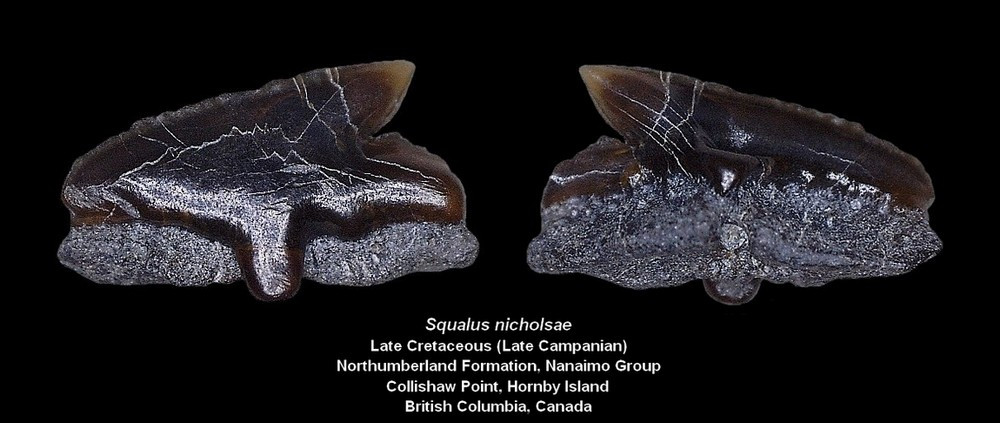
Squalus nicholsae Cappetta, Morrison & Adnet, 2019, Late Cretaceous, Late Campanian, Northumberland Formation, Nanalmo Group, Collishaw Point, Hornby Island, Canada, collection and © Adam Anderson
Squalus nicholsae Cappetta, Morrison & Adnet, 2019, Late Cretaceous, Late Campanian, Northumberland Formation, Nanalmo Group, Collishaw Point, Hornby Island, Canada, collection and © Adam Anderson
Description
Original diagnosis after Cappetta, Morrison & Adnet, 2019 [27810]: Teeth with a straight mesial cutting edge strongly serrated, except in its apical section, this being smooth and separated by a distinct notch. The distal cutting edge of the cusp is slightly convex along with the presence of a high distal heel more or less rounded and high according to the position of the tooth. The basal limit of the labial face overhangs the labial face of the root by strong irregularities from either side of the apron. The short apron is rather vertical and not very broad, with a very rounded extremity that does not necessarily exceed the basal limits of the root. The limits of the labial face show a notch below the distal heel and a notch below the beginning of the mesial cutting edge. In lingual view, there is a thin uvula located practically at the centre of the tooth.
Very close to those of S. argentinensis, the teeth of S. nicholsae nov. sp separate themselves by exhibiting a thinner apron, a more irregular limit of the crown above the labial face of the root, a thinner uvula and a more serrated mesial cutting edge that is separated by a distinct notch from the cusps smooth apical section.
Original diagnosis after Cappetta, Morrison & Adnet, 2019 [27810]: Teeth with a straight mesial cutting edge strongly serrated, except in its apical section, this being smooth and separated by a distinct notch. The distal cutting edge of the cusp is slightly convex along with the presence of a high distal heel more or less rounded and high according to the position of the tooth. The basal limit of the labial face overhangs the labial face of the root by strong irregularities from either side of the apron. The short apron is rather vertical and not very broad, with a very rounded extremity that does not necessarily exceed the basal limits of the root. The limits of the labial face show a notch below the distal heel and a notch below the beginning of the mesial cutting edge. In lingual view, there is a thin uvula located practically at the centre of the tooth.
Very close to those of S. argentinensis, the teeth of S. nicholsae nov. sp separate themselves by exhibiting a thinner apron, a more irregular limit of the crown above the labial face of the root, a thinner uvula and a more serrated mesial cutting edge that is separated by a distinct notch from the cusps smooth apical section.
References

Bioluminescence and repeated deep-sea colonization shaped the diversification and body size evolution of squaliform sharks. Proceedings of the Royal Society B-Biological Sciences, 292(2042), Article 20242932
DOI: 10.1098/rspb.2024.2932
Global impact and selectivity of the Cretaceous-Paleogene mass extinction among sharks, skates, and rays. Science, 379, 802–806
DOI: 10.1126/science.abn2080

Oldest evidence of the genus Squalus in the north alpine realm with remarks on its evolution and distribution through time. Paleoichthys, 2, 1–9
A shark fauna from the Campanian of Hornby Island, British Columbia, Canada: an insight into the diversity of Cretaceous deep-water assemblages. Historical Biology, 33(8), 1121–1182
DOI: 10.1080/08912963.2019.1681421
Bioluminescence and repeated deep-sea colonization shaped the diversification and body size evolution of squaliform sharks. Proceedings of the Royal Society B-Biological Sciences, 292(2042), Article 20242932
DOI: 10.1098/rspb.2024.2932
Global impact and selectivity of the Cretaceous-Paleogene mass extinction among sharks, skates, and rays. Science, 379, 802–806
DOI: 10.1126/science.abn2080
Oldest evidence of the genus Squalus in the north alpine realm with remarks on its evolution and distribution through time. Paleoichthys, 2, 1–9
A shark fauna from the Campanian of Hornby Island, British Columbia, Canada: an insight into the diversity of Cretaceous deep-water assemblages. Historical Biology, 33(8), 1121–1182
DOI: 10.1080/08912963.2019.1681421