


Pristiophorus smithi
Cappetta, Morrison & Adnet, 2019
Classification: Elasmobranchii Pristiophoriformes Pristiophoridae
Reference of the original description
A shark fauna from the Campanian of Hornby Island, British Columbia, Canada: an insight into the diversity of Cretaceous deep-water assemblages. Historical Biology, 33(8), 1121–1182
A shark fauna from the Campanian of Hornby Island, British Columbia, Canada: an insight into the diversity of Cretaceous deep-water assemblages. Historical Biology, 33(8), 1121–1182
Description:
Citation: Pristiophorus smithi Cappetta, Morrison & Adnet, 2019: In: Database of fossil elasmobranch teeth www.shark-references.com, World Wide Web electronic publication, Version 10/2026
Please send your images of "Pristiophorus smithi" to info@shark-references.com
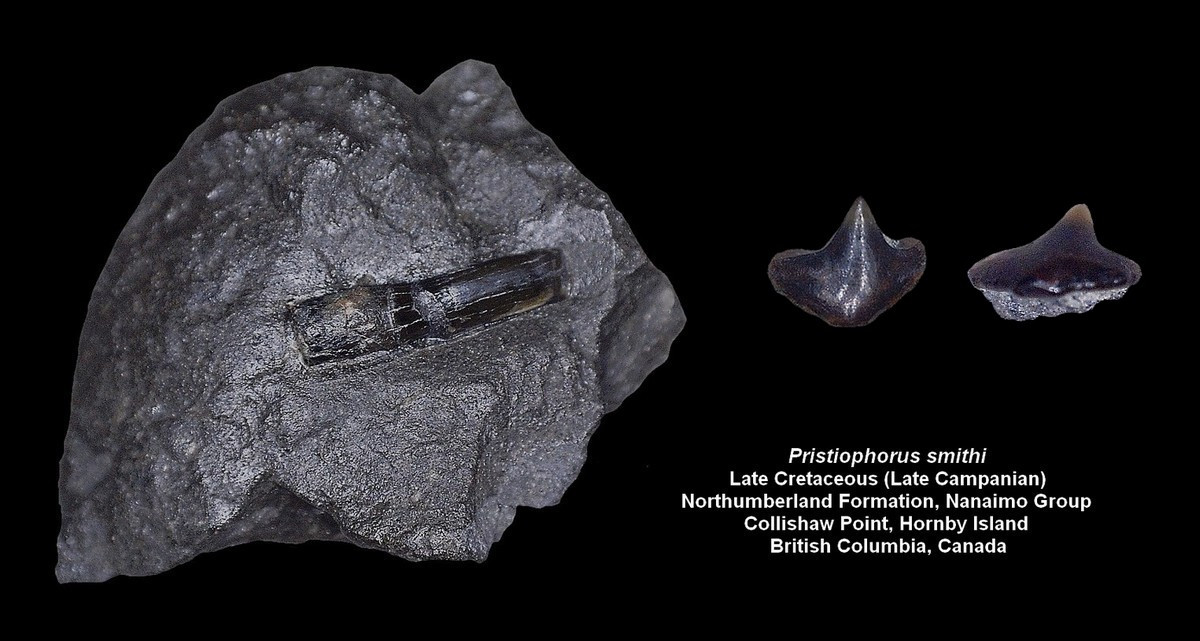
Pristiophorus smithi Cappetta, Morrison & Adnet, 2019, Late Cretaceous, Late Campanian, Northumberland Formation, Nanalmo Group, Collishaw Point, Hornby Island, Canada, collection and © Adam Anderson
Pristiophorus smithi Cappetta, Morrison & Adnet, 2019, Late Cretaceous, Late Campanian, Northumberland Formation, Nanalmo Group, Collishaw Point, Hornby Island, Canada, collection and © Adam Anderson
Description
Original diagnosis after Cappetta, Morrison & Adnet, 2019 [27810]: Rostral teeth are characterised by the combination of the following characters: cusp with parallel cutting edges on its proximal sides that almost reach the apex, where it has a distinct narrowing apical tip with completely smooth enameloid; anterior and posterior cutting edges straight or slightly convex anteriorly and concave posteriorly; upper and lower faces bear numerous well-marked straight parallel folds dividing, becoming finer towards the apex; presence of a salient more or less oblique bulge at the base of the cusp that overhangs the peduncle. The peduncle is not very high, with a straight anterior profile and a concave posterior one. In a very small tooth, the peduncle is higher than the cusp.
The rostral teeth of P. smithi differentiate from those of P. pricei by their smaller size, a cusp strongly folded, a peduncle relatively higher and the apical part of the crown that distinctly narrows to a pointed tip. Oral teeth are characterised by the combination of the following characters: teeth broader than long in occlusal view, with a median cusp sharp, erect and slightly bent lingually; basal limit of the labial face overhanging the root by a broad and convex apron; occurrence of a pair of low cusplets on the marginal heels, with small diverging crests; some fine and superficial folds radiating on the labial face, down to the basal limit of the crown; lingual protuberance triangular in occlusal view, well separated from the lingual limit of the crown. In lateral teeth, the apron is regularly convex and bears small short crests all along its width, and a shorter less salient lingual protuberance. Root of P. smithi, practically as broad as the crown in occlusal view, is anaulacorhizous, kidney-shaped, with a flat basal face and ducts going through labio-lingually.
Oral teeth of P. smithi differentiates from those of P. pricei by their smaller size, less high cusp, occurrence of marginal cusplets and folds on the labial face of the crown, sometimes also on the lingual one, root not overpassing the crown marginally. Limit of the apron is regularly convex contrary to P. pricei, which shows a distinct angular median outline. Moreover, the lingual protuberance is better separated from the lingual limit of the crown.
Original diagnosis after Cappetta, Morrison & Adnet, 2019 [27810]: Rostral teeth are characterised by the combination of the following characters: cusp with parallel cutting edges on its proximal sides that almost reach the apex, where it has a distinct narrowing apical tip with completely smooth enameloid; anterior and posterior cutting edges straight or slightly convex anteriorly and concave posteriorly; upper and lower faces bear numerous well-marked straight parallel folds dividing, becoming finer towards the apex; presence of a salient more or less oblique bulge at the base of the cusp that overhangs the peduncle. The peduncle is not very high, with a straight anterior profile and a concave posterior one. In a very small tooth, the peduncle is higher than the cusp.
The rostral teeth of P. smithi differentiate from those of P. pricei by their smaller size, a cusp strongly folded, a peduncle relatively higher and the apical part of the crown that distinctly narrows to a pointed tip. Oral teeth are characterised by the combination of the following characters: teeth broader than long in occlusal view, with a median cusp sharp, erect and slightly bent lingually; basal limit of the labial face overhanging the root by a broad and convex apron; occurrence of a pair of low cusplets on the marginal heels, with small diverging crests; some fine and superficial folds radiating on the labial face, down to the basal limit of the crown; lingual protuberance triangular in occlusal view, well separated from the lingual limit of the crown. In lateral teeth, the apron is regularly convex and bears small short crests all along its width, and a shorter less salient lingual protuberance. Root of P. smithi, practically as broad as the crown in occlusal view, is anaulacorhizous, kidney-shaped, with a flat basal face and ducts going through labio-lingually.
Oral teeth of P. smithi differentiates from those of P. pricei by their smaller size, less high cusp, occurrence of marginal cusplets and folds on the labial face of the crown, sometimes also on the lingual one, root not overpassing the crown marginally. Limit of the apron is regularly convex contrary to P. pricei, which shows a distinct angular median outline. Moreover, the lingual protuberance is better separated from the lingual limit of the crown.
References

Global impact and selectivity of the Cretaceous-Paleogene mass extinction among sharks, skates, and rays. Science, 379, 802–806
DOI: 10.1126/science.abn2080
A shark fauna from the Campanian of Hornby Island, British Columbia, Canada: an insight into the diversity of Cretaceous deep-water assemblages. Historical Biology, 33(8), 1121–1182
DOI: 10.1080/08912963.2019.1681421
Global impact and selectivity of the Cretaceous-Paleogene mass extinction among sharks, skates, and rays. Science, 379, 802–806
DOI: 10.1126/science.abn2080
A shark fauna from the Campanian of Hornby Island, British Columbia, Canada: an insight into the diversity of Cretaceous deep-water assemblages. Historical Biology, 33(8), 1121–1182
DOI: 10.1080/08912963.2019.1681421