


Carcharias dominguei
Cappetta, Morrison & Adnet, 2019
Classification: Elasmobranchii Lamniformes Carchariidae
Reference of the original description
A shark fauna from the Campanian of Hornby Island, British Columbia, Canada: an insight into the diversity of Cretaceous deep-water assemblages. Historical Biology, 33(8), 1121–1182
A shark fauna from the Campanian of Hornby Island, British Columbia, Canada: an insight into the diversity of Cretaceous deep-water assemblages. Historical Biology, 33(8), 1121–1182
Types
Carcharias dominguei
Holotype: RBCM: P1268; Paratype: RBCM: P1267; RBCM: P1271; RBCM: P1273; RBCM: P1314; RBCM: P1280;
Carcharias dominguei
Holotype: RBCM: P1268; Paratype: RBCM: P1267; RBCM: P1271; RBCM: P1273; RBCM: P1314; RBCM: P1280;
Description:
Citation: Carcharias dominguei Cappetta, Morrison & Adnet, 2019: In: Database of fossil elasmobranch teeth www.shark-references.com, World Wide Web electronic publication, Version 10/2026
Please send your images of "Carcharias dominguei" to info@shark-references.com
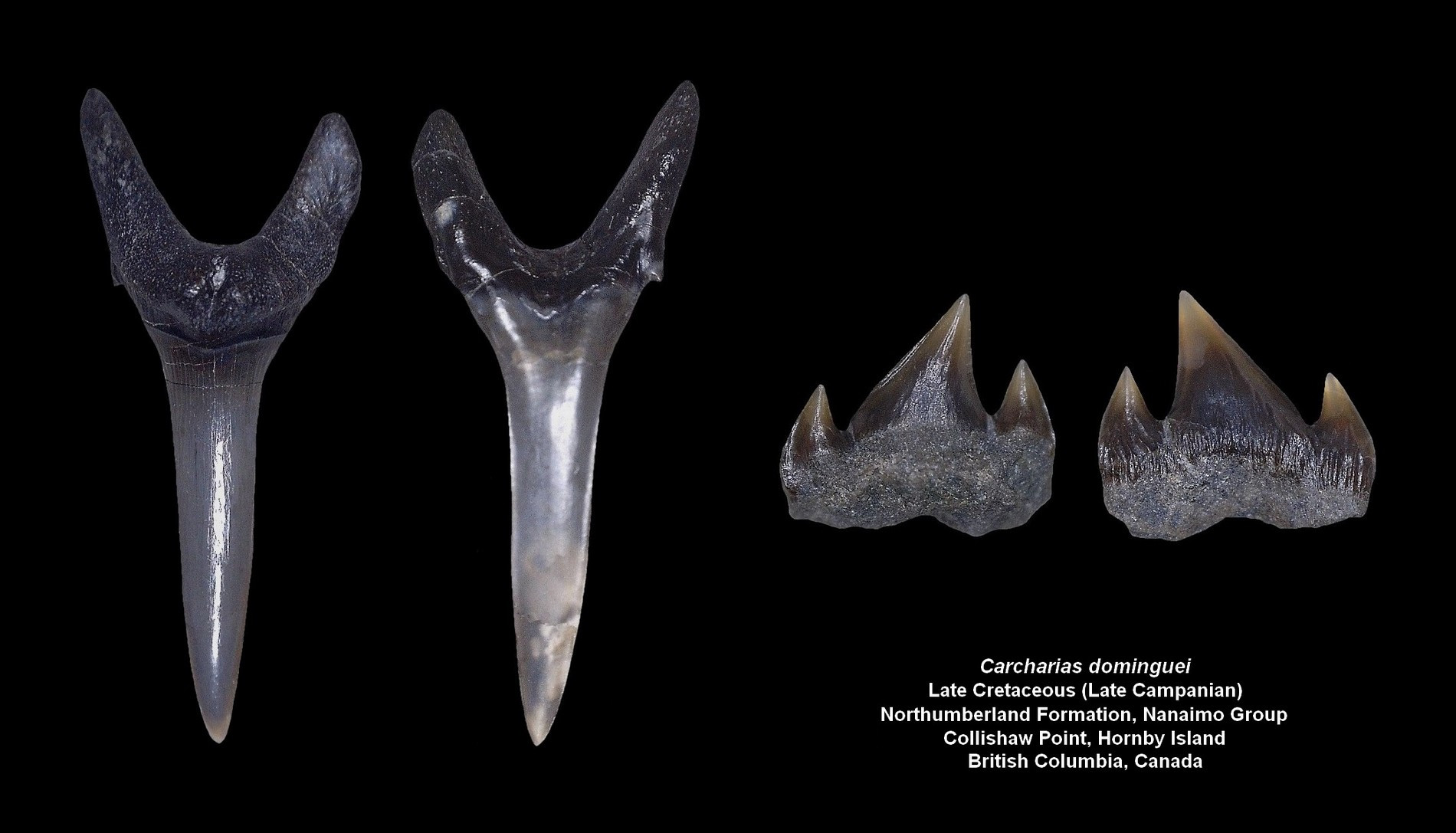
Carcharias dominguei Cappetta, Morrison & Adnet, 2019, Late Cretaceous, Late Campanian, Northumberland Formation, Nanalmo Group, Collishaw Point, Hornby Island, Canada, collection and © Adam Anderson
Carcharias dominguei Cappetta, Morrison & Adnet, 2019, Late Cretaceous, Late Campanian, Northumberland Formation, Nanalmo Group, Collishaw Point, Hornby Island, Canada, collection and © Adam Anderson
Description
Original diagnosis after Cappetta, Morrison & Adnet, 2019 [27810]: Dentition rather similar overall to that of the Recent Carcharias taurus. Anterior teeth with a high, erect cusp showing a slight sigmoid profile and slightly bent lingually. Base of the cusp distinctly broadening and well separated from a pair of short, sharp and hook-like marginal cusplets converging towards the base of the crown. The base of the labial face of the cusp is concave and overhangs the root without forming a bulge. The labial face of the cusp is not very convex transversely and completely smooth, whereas the lingual face is very convex and bears between 20 and 25 close and vertical folds on its lower half. Lingually, the base of the cusp is separated from the root by a broad and hollowed neck. The root lobes are separated by a deep basal concavity. The lingual protuberance is salient and divided by a deep axial groove. The main differences depend on the position the teeth occupied in the mouth as in the Recent Carcharias taurus. The root lobes in lateral files diverge and the basal margin of the root is concave (more/less) in labial view. In some lateral teeth, one can note the occurrence of two pairs of cusplets, erect and relatively more important than in anterior files. In very lateral teeth, the relative importance of the cusplets increases, and in some posterior teeth, the labial base of the crown forms a slight bulge bearing short vertical folds oblique marginally, straight medially.
Original diagnosis after Cappetta, Morrison & Adnet, 2019 [27810]: Dentition rather similar overall to that of the Recent Carcharias taurus. Anterior teeth with a high, erect cusp showing a slight sigmoid profile and slightly bent lingually. Base of the cusp distinctly broadening and well separated from a pair of short, sharp and hook-like marginal cusplets converging towards the base of the crown. The base of the labial face of the cusp is concave and overhangs the root without forming a bulge. The labial face of the cusp is not very convex transversely and completely smooth, whereas the lingual face is very convex and bears between 20 and 25 close and vertical folds on its lower half. Lingually, the base of the cusp is separated from the root by a broad and hollowed neck. The root lobes are separated by a deep basal concavity. The lingual protuberance is salient and divided by a deep axial groove. The main differences depend on the position the teeth occupied in the mouth as in the Recent Carcharias taurus. The root lobes in lateral files diverge and the basal margin of the root is concave (more/less) in labial view. In some lateral teeth, one can note the occurrence of two pairs of cusplets, erect and relatively more important than in anterior files. In very lateral teeth, the relative importance of the cusplets increases, and in some posterior teeth, the labial base of the crown forms a slight bulge bearing short vertical folds oblique marginally, straight medially.
References

Global impact and selectivity of the Cretaceous-Paleogene mass extinction among sharks, skates, and rays. Science, 379, 802–806
DOI: 10.1126/science.abn2080
A shark fauna from the Campanian of Hornby Island, British Columbia, Canada: an insight into the diversity of Cretaceous deep-water assemblages. Historical Biology, 33(8), 1121–1182
DOI: 10.1080/08912963.2019.1681421
Global impact and selectivity of the Cretaceous-Paleogene mass extinction among sharks, skates, and rays. Science, 379, 802–806
DOI: 10.1126/science.abn2080
A shark fauna from the Campanian of Hornby Island, British Columbia, Canada: an insight into the diversity of Cretaceous deep-water assemblages. Historical Biology, 33(8), 1121–1182
DOI: 10.1080/08912963.2019.1681421