


Florenceodon johnyi
Cappetta, Morrison & Adnet, 2019
Classification: Elasmobranchii Carcharhiniformes Florenceodontidae
Reference of the original description
A shark fauna from the Campanian of Hornby Island, British Columbia, Canada: an insight into the diversity of Cretaceous deep-water assemblages. Historical Biology, 33(8), 1121–1182
A shark fauna from the Campanian of Hornby Island, British Columbia, Canada: an insight into the diversity of Cretaceous deep-water assemblages. Historical Biology, 33(8), 1121–1182
Description:
Citation: Florenceodon johnyi Cappetta, Morrison & Adnet, 2019: In: Database of fossil elasmobranch teeth www.shark-references.com, World Wide Web electronic publication, Version 10/2026
Please send your images of "Florenceodon johnyi" to info@shark-references.com
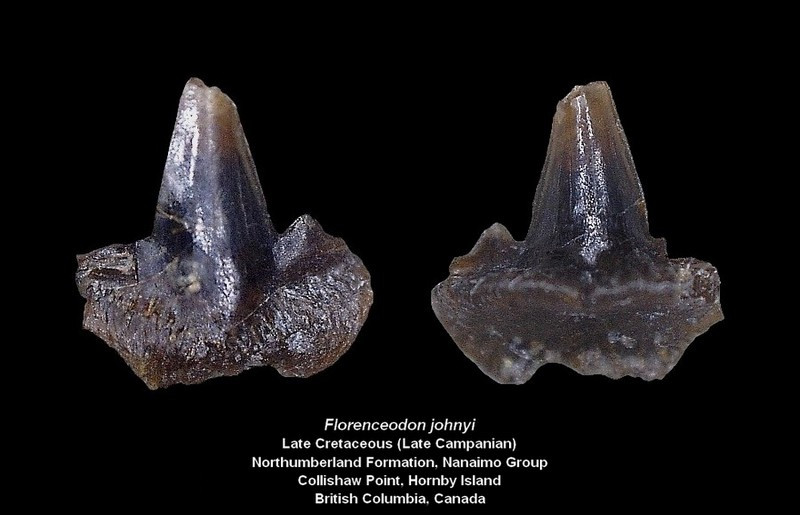
Florenceodon johnyi Cappetta, Morrison & Adnet, 2019, Late Cretaceous, Late Campanian, Northumberland Formation, Nanalmo Group, Collishaw Point, Hornby Island, Canada, collection and © Adam Anderson
Florenceodon johnyi Cappetta, Morrison & Adnet, 2019, Late Cretaceous, Late Campanian, Northumberland Formation, Nanalmo Group, Collishaw Point, Hornby Island, Canada, collection and © Adam Anderson
Description
Original diagnosis after Cappetta, Morrison & Adnet, 2019 [27810]: As the family is monotypic, the diagnosis is the same also for the genus and species. This family is only known by isolated teeth. Teeth not exceeding 8 mm in total height (according to the material currently available). The dentition is characterised by a well-marked heterodonty. Anterior teeth little mesio-distally developed showing an erect and sharp cusp, devoid of lateral cusplets. More lateral teeth with a broader cusp, and a pair of low and elongated lateral cusplets, sometimes absent, present on both side or just one side of the main cusp. Basal face of the root clearly concave in profile, except in very lateral files where it is flat.
Original diagnosis after Cappetta, Morrison & Adnet, 2019 [27810]: As the family is monotypic, the diagnosis is the same also for the genus and species. This family is only known by isolated teeth. Teeth not exceeding 8 mm in total height (according to the material currently available). The dentition is characterised by a well-marked heterodonty. Anterior teeth little mesio-distally developed showing an erect and sharp cusp, devoid of lateral cusplets. More lateral teeth with a broader cusp, and a pair of low and elongated lateral cusplets, sometimes absent, present on both side or just one side of the main cusp. Basal face of the root clearly concave in profile, except in very lateral files where it is flat.
Remarks
shark-references Species-ID=15545;
type species of Florenceodon Cappetta, Morrison & Adnet, 2019 [27810] by original designation (Art. 68.2 ICZN);
valid after Cappetta, Morrison & Adnet, 2021 [27810]
shark-references Species-ID=15545;
type species of Florenceodon Cappetta, Morrison & Adnet, 2019 [27810] by original designation (Art. 68.2 ICZN);
valid after Cappetta, Morrison & Adnet, 2021 [27810]
References

Global impact and selectivity of the Cretaceous-Paleogene mass extinction among sharks, skates, and rays. Science, 379, 802–806
DOI: 10.1126/science.abn2080

Combining palaeontological and neontological data shows a delayed diversification burst of carcharhiniform sharks likely mediated by environmental change. Scientific Reports, 12, Article 21906
DOI: 10.1038/s41598-022-26010-7
A shark fauna from the Campanian of Hornby Island, British Columbia, Canada: an insight into the diversity of Cretaceous deep-water assemblages. Historical Biology, 33(8), 1121–1182
DOI: 10.1080/08912963.2019.1681421
Global impact and selectivity of the Cretaceous-Paleogene mass extinction among sharks, skates, and rays. Science, 379, 802–806
DOI: 10.1126/science.abn2080
Combining palaeontological and neontological data shows a delayed diversification burst of carcharhiniform sharks likely mediated by environmental change. Scientific Reports, 12, Article 21906
DOI: 10.1038/s41598-022-26010-7
A shark fauna from the Campanian of Hornby Island, British Columbia, Canada: an insight into the diversity of Cretaceous deep-water assemblages. Historical Biology, 33(8), 1121–1182
DOI: 10.1080/08912963.2019.1681421