


Strophodus dunaii
(Szabó & Főzy, 2020)
Classification: Elasmobranchii Hybodontiformes Acrodontidae
Reference of the original description
Asteracanthus (Hybodontiformes: Acrodontidae) remains from the Jurassic of Hungary, with the description of a new species and with remarks on the taxonomy and paleobiology of the genus. Neues Jahrbuch für Geologie und Paläontologie, Abhandlungen, 297(3), 295–309
Asteracanthus (Hybodontiformes: Acrodontidae) remains from the Jurassic of Hungary, with the description of a new species and with remarks on the taxonomy and paleobiology of the genus. Neues Jahrbuch für Geologie und Paläontologie, Abhandlungen, 297(3), 295–309
Synonyms / new combinations and misspellings
Asteracanthus dunaii
Asteracanthus dunaii
Description:
Citation: Strophodus dunaii (Szabó & Főzy, 2020): In: Database of fossil elasmobranch teeth www.shark-references.com, World Wide Web electronic publication, Version 10/2026
Please send your images of "Strophodus dunaii" to info@shark-references.com

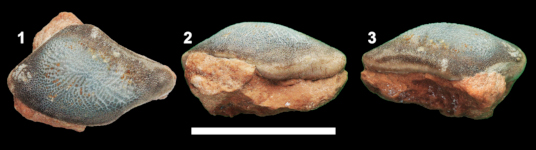
Asteracanthus dunaii Szabó & Főzy, 2020; holotype, NHMUS PAL 2020.1.1, Tölgyhát Limestone Formation; Murchisonae Zone, Opalinoides Subzone, Middle Jurassic (Aalenian), Tűzköves Ravine, south from Bakonycsernye, Hungary. © Márton Szabó, Hungarian Natural History Museum
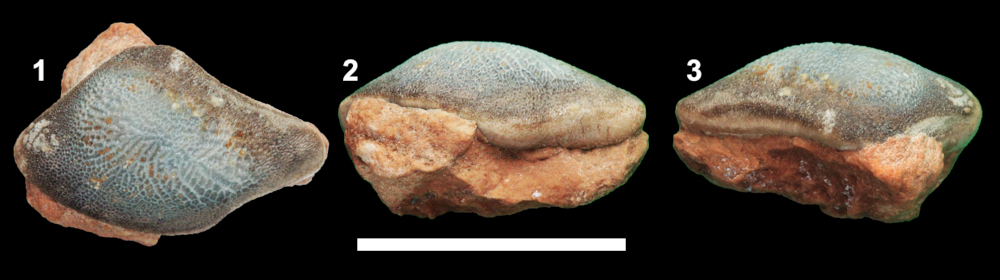
Asteracanthus dunaii Szabó & Főzy, 2020; holotype, NHMUS PAL 2020.1.1, Tölgyhát Limestone Formation; Murchisonae Zone, Opalinoides Subzone, Middle Jurassic (Aalenian), Tűzköves Ravine, south from Bakonycsernye, Hungary. © Márton Szabó, Hungarian Natural History Museum
Description
Original diagnosis after Szabó & Főzy (2020) p. 299: Hybodontiform shark with crushing-type dentition with richly ornamented teeth, differing from other species of Asteracanthus by the combination of the following dental characteristics. The occlusal ornamentation of the teeth is composed by frequently branching folds and ridges at the higher crown parts turning into a minutely reticulate pattern towards the crown edges. No occlusal crest is present. The crown of the teeth bears a low and wide transversal ridge runs along almost the entire crown surface close to the labial edge. The labial and distal crown edges of the teeth are flattened. Teeth of the second anterior file have a low, occlusally triangular crown. The mesial extremity of teeth of the first lateral file is labially projected. The second lateral teeth are weakly arched with angled extremities, of which the mesial one is weakly domed. The cross-section view of the teeth is asymmetrical, hat- like, caused by the low and wide labially oriented transversal ridge.
Original diagnosis after Szabó & Főzy (2020) p. 299: Hybodontiform shark with crushing-type dentition with richly ornamented teeth, differing from other species of Asteracanthus by the combination of the following dental characteristics. The occlusal ornamentation of the teeth is composed by frequently branching folds and ridges at the higher crown parts turning into a minutely reticulate pattern towards the crown edges. No occlusal crest is present. The crown of the teeth bears a low and wide transversal ridge runs along almost the entire crown surface close to the labial edge. The labial and distal crown edges of the teeth are flattened. Teeth of the second anterior file have a low, occlusally triangular crown. The mesial extremity of teeth of the first lateral file is labially projected. The second lateral teeth are weakly arched with angled extremities, of which the mesial one is weakly domed. The cross-section view of the teeth is asymmetrical, hat- like, caused by the low and wide labially oriented transversal ridge.
Image gallery
References

Fossil chondrichthyans of the Carpathian-Pannonian Region (in Hungarian: A Kárpát-Pannon-térség fosszilis porcoshalai). Hungarian Natural History Museum, Dabasi Nyomda Zrt., Budapest. 255 pages, ISBN 978-963-9877-52-8

Root resorption during tooth replacement in sharks – a unique character of the Hybodontiformes (Chondrichthyes, Elasmobranchii). Palaeodiversity, 17(1), 121–194
DOI: 10.18476/pale.v17.a6
Brief notes on newly discovered teeth of the hybodontiform shark Strophodus dunaii (Szabó et Főzy, 2020). Fragmenta Palaeontologica Hungarica, 37, 3–11
DOI: 10.17111/FragmPalHung.2021.37.3
Asteracanthus (Hybodontiformes: Acrodontidae) remains from the Jurassic of Hungary, with the description of a new species and with remarks on the taxonomy and paleobiology of the genus. Neues Jahrbuch für Geologie und Paläontologie, Abhandlungen, 297(3), 295–309
DOI: 10.1127/njgpa/2020/0926
Fossil chondrichthyans of the Carpathian-Pannonian Region (in Hungarian: A Kárpát-Pannon-térség fosszilis porcoshalai). Hungarian Natural History Museum, Dabasi Nyomda Zrt., Budapest. 255 pages, ISBN 978-963-9877-52-8
Root resorption during tooth replacement in sharks – a unique character of the Hybodontiformes (Chondrichthyes, Elasmobranchii). Palaeodiversity, 17(1), 121–194
DOI: 10.18476/pale.v17.a6
Brief notes on newly discovered teeth of the hybodontiform shark Strophodus dunaii (Szabó et Főzy, 2020). Fragmenta Palaeontologica Hungarica, 37, 3–11
DOI: 10.17111/FragmPalHung.2021.37.3
Asteracanthus (Hybodontiformes: Acrodontidae) remains from the Jurassic of Hungary, with the description of a new species and with remarks on the taxonomy and paleobiology of the genus. Neues Jahrbuch für Geologie und Paläontologie, Abhandlungen, 297(3), 295–309
DOI: 10.1127/njgpa/2020/0926