


Magwayodus boboi
Adnet, Valentin, Chaimanee, Soe, Sein & Jaeger, 2026
Classification: Elasmobranchii Carcharhiniformes Carcharhinidae
Reference of the original description
Upper Eocene elasmobranch assemblages from Myanmar: Evidence for the easternmost dispersal pathways across the Neotethys. Palaeoworld, 35(6), Article 201169
Upper Eocene elasmobranch assemblages from Myanmar: Evidence for the easternmost dispersal pathways across the Neotethys. Palaeoworld, 35(6), Article 201169
Image of the original description
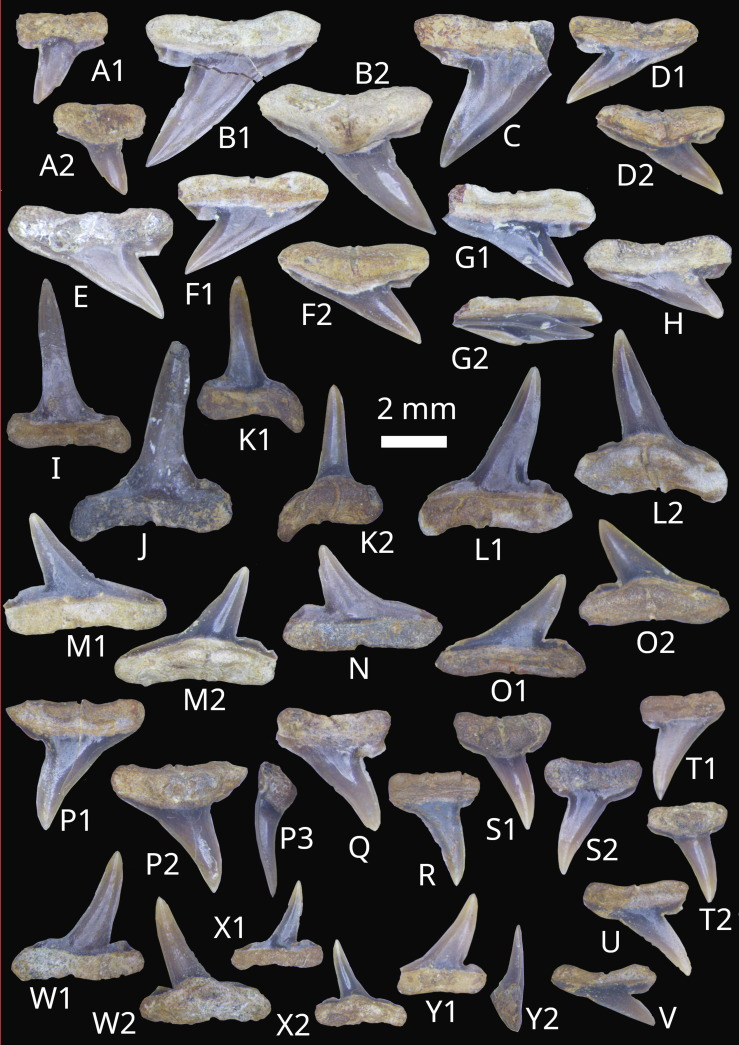
Magwayodus boboi Adnet, Valentin, Chaimanee, Soe, Sein & Jaeger, 2026; Yaw Formation, Priabonian, near Bahin village, Myaing Township, central Myanmar © Adnet, Valentin, Chaimanee, Soe, Sein & Jaeger, 2026
Magwayodus boboi Adnet, Valentin, Chaimanee, Soe, Sein & Jaeger, 2026; Yaw Formation, Priabonian, near Bahin village, Myaing Township, central Myanmar © Adnet, Valentin, Chaimanee, Soe, Sein & Jaeger, 2026
Images of types
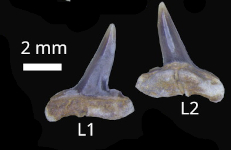
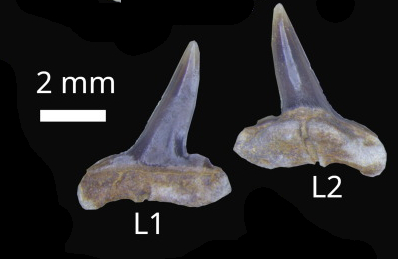
Description:
Citation: Magwayodus boboi Adnet, Valentin, Chaimanee, Soe, Sein & Jaeger, 2026: In: Database of fossil elasmobranch teeth www.shark-references.com, World Wide Web electronic publication, Version 10/2026
Description
Diagnosis afterAdnet, Valentin, Chaimanee, Soe, Sein & Jaeger, 2026 [36178]: This medium-sized carcharhinid genus is characterised by strong dignathic heterodonty. Upper teeth possess curved, elongate, blade-like fine cusps that are distally inclined, whereas lower teeth, at least in the anterior files, have high and erect fine cusps. The cutting edges of both cusps and heels are entirely smooth in both jaws. A low pseudo-cusplet is occasionally observed on the distal heel. Notably, the lower teeth displayed a distinctly slender root, with the mesial extremity tending to extend basally, particularly in the anterior and antero-lateral files. In contrast, the root of the upper teeth is relatively symmetric, with a labial face peculiarly convex at its basal extremity, producing a cusp that is angular relative to the root face. Ontogenetic variation is evidenced by less pronounced heterodonty in juveniles compared to adults.
Diagnosis afterAdnet, Valentin, Chaimanee, Soe, Sein & Jaeger, 2026 [36178]: This medium-sized carcharhinid genus is characterised by strong dignathic heterodonty. Upper teeth possess curved, elongate, blade-like fine cusps that are distally inclined, whereas lower teeth, at least in the anterior files, have high and erect fine cusps. The cutting edges of both cusps and heels are entirely smooth in both jaws. A low pseudo-cusplet is occasionally observed on the distal heel. Notably, the lower teeth displayed a distinctly slender root, with the mesial extremity tending to extend basally, particularly in the anterior and antero-lateral files. In contrast, the root of the upper teeth is relatively symmetric, with a labial face peculiarly convex at its basal extremity, producing a cusp that is angular relative to the root face. Ontogenetic variation is evidenced by less pronounced heterodonty in juveniles compared to adults.
Remarks
shark-references Species-ID=17865;
type species of Magwayodus Adnet, Valentin, Chaimanee, Soe, Sein & Jaeger, 2026 [36178] by monotypy (Art. 68.3 ICZN)
shark-references Species-ID=17865;
type species of Magwayodus Adnet, Valentin, Chaimanee, Soe, Sein & Jaeger, 2026 [36178] by monotypy (Art. 68.3 ICZN)
References


Upper Eocene elasmobranch assemblages from Myanmar: Evidence for the easternmost dispersal pathways across the Neotethys. Palaeoworld, 35(6), Article 201169
DOI: 10.1016/j.palwor.2026.201169
Upper Eocene elasmobranch assemblages from Myanmar: Evidence for the easternmost dispersal pathways across the Neotethys. Palaeoworld, 35(6), Article 201169
DOI: 10.1016/j.palwor.2026.201169