


 Catalog of Fishes
 literature references
 FishBase
 NCBI GenBank
Apristurus drona
Beura, Bineesh & Banerjee, 2026
Classification: Elasmobranchii Carcharhiniformes Pentanchidae
Reference of the original description
DNA barcoding reveals a new species of deepwater catshark of the genus Apristurus (Chondrichthyes: Pentanchidae) from India, in the Southeastern Arabian Sea. Zootaxa, 5828(2), 303–317
DNA barcoding reveals a new species of deepwater catshark of the genus Apristurus (Chondrichthyes: Pentanchidae) from India, in the Southeastern Arabian Sea. Zootaxa, 5828(2), 303–317
Types
Apristurus drona
Holotype: MBRC: ZSI/MBRC/F3296; Paratype: MBRC: ZSI/MBRC/F3297; MBRC: ZSI/MBRC/F3298; MBRC: ZSI/MBRC/F3299;
Apristurus drona
Holotype: MBRC: ZSI/MBRC/F3296; Paratype: MBRC: ZSI/MBRC/F3297; MBRC: ZSI/MBRC/F3298; MBRC: ZSI/MBRC/F3299;
Images of types
Description :
Citation: Apristurus drona Beura, Bineesh & Banerjee, 2026: In: Database of modern sharks, rays and chimaeras, www.shark-references.com, World Wide Web electronic publication, Version 10/2026
Please send your images of "Apristurus drona" to info@shark-references.com
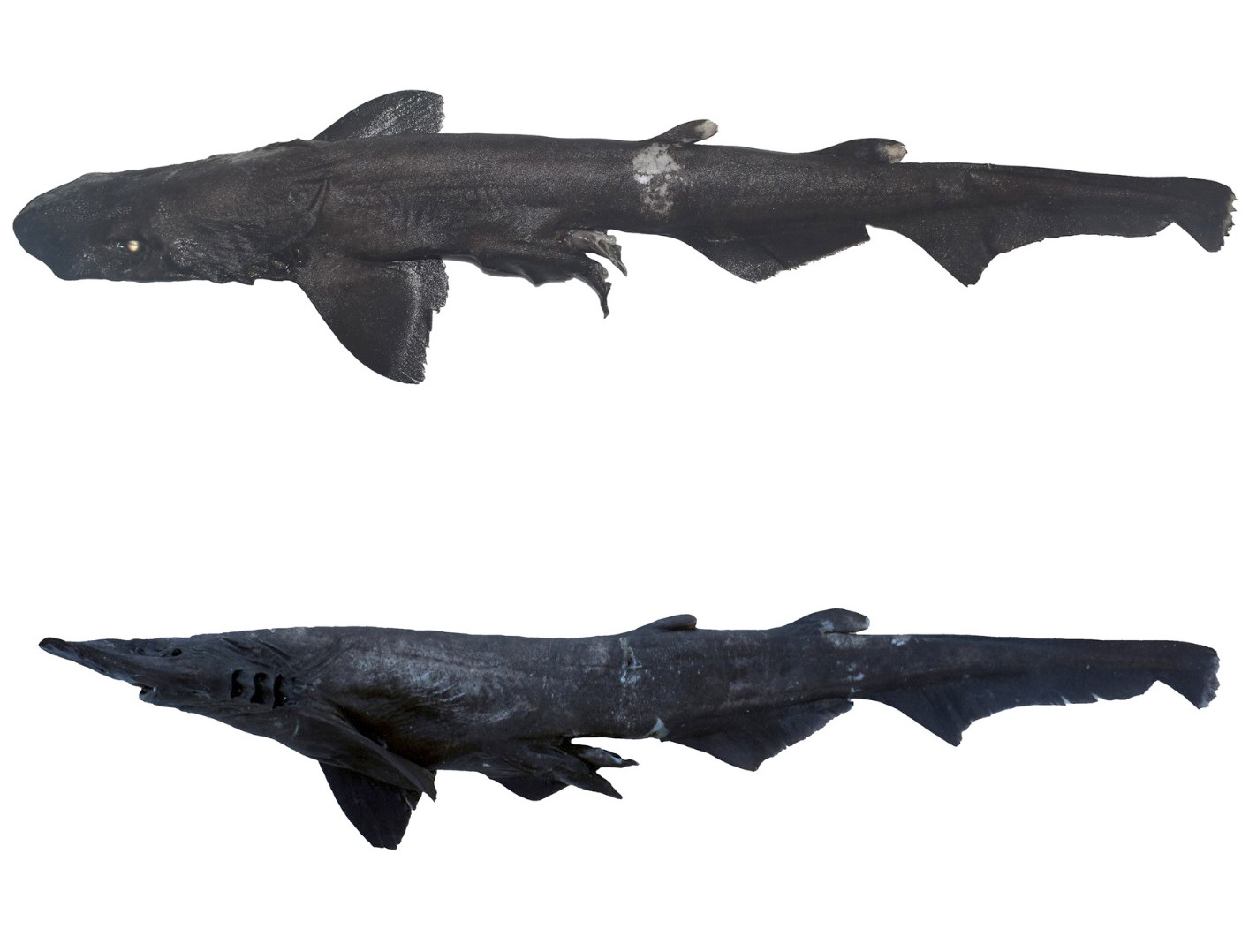
Apristurus drona Beura, Bineesh & Banerjee, 2026; Holotype, ZSI/MBRC/F3296, adult male, 473 mm TL, lateral view, Paratype 1, ZSI/MBRC/F3297, adult male, 462 mm TL, lateral view © Sweta Beura
Apristurus drona Beura, Bineesh & Banerjee, 2026; Holotype, ZSI/MBRC/F3296, adult male, 473 mm TL, lateral view, Paratype 1, ZSI/MBRC/F3297, adult male, 462 mm TL, lateral view © Sweta Beura
Short Description
Diagnosis after Beura, Bineesh & Banerjee, 2026 [35997]: A species of Apristurus with the following combination of characters: slender body; snout angular and pointed; nostril length is smaller than internarial width; pre-outer nostril length shorter than interorbital space; pre-oral length smaller than the preorbital length; pre-outer nostril length 3.7 (3.5–5.2) % TL; pre-oral length shorter than the mouth width, 33.6 (31.7–34.0)% head length and 8.1 (7.1–8.1)% TL; nostril-mouth space shorter than nostril length, about 0.4 (0.3–0.4) times; upper labial furrows longer than the lowers furrows; internarial width slightly greater than or equal to orbit length, about 1.09 (1.0–1.11) times; inter-gill length 24.4 (24.4–28.5)% TL head length; 5th gill slit height smallest, about 46.8 (46.8–62.5)% eye length; inter-dorsal space 9.3 (8.8–10.5) % TL; first dorsal fin smaller than the second dorsal fin, its origin at pelvic-anal midspace; first dorsal fin insertion is opposite to anal fin origin; anal fin base length is greater than pectoral-pelvic space and pelvic-anal space; pectoral to pelvic space greater than pelvic to anal space; pelvic to anal space 7.5 (5.5–7.5) % TL; spiral valve turns 11–12; monospondylous vertebrae 33–34; dispondylous precaudal vertebrae 37–42; precaudal vertebrae 70–76; caudal vertebrae 35–39; total vertebrae 105–115.
Diagnosis after Beura, Bineesh & Banerjee, 2026 [35997]: A species of Apristurus with the following combination of characters: slender body; snout angular and pointed; nostril length is smaller than internarial width; pre-outer nostril length shorter than interorbital space; pre-oral length smaller than the preorbital length; pre-outer nostril length 3.7 (3.5–5.2) % TL; pre-oral length shorter than the mouth width, 33.6 (31.7–34.0)% head length and 8.1 (7.1–8.1)% TL; nostril-mouth space shorter than nostril length, about 0.4 (0.3–0.4) times; upper labial furrows longer than the lowers furrows; internarial width slightly greater than or equal to orbit length, about 1.09 (1.0–1.11) times; inter-gill length 24.4 (24.4–28.5)% TL head length; 5th gill slit height smallest, about 46.8 (46.8–62.5)% eye length; inter-dorsal space 9.3 (8.8–10.5) % TL; first dorsal fin smaller than the second dorsal fin, its origin at pelvic-anal midspace; first dorsal fin insertion is opposite to anal fin origin; anal fin base length is greater than pectoral-pelvic space and pelvic-anal space; pectoral to pelvic space greater than pelvic to anal space; pelvic to anal space 7.5 (5.5–7.5) % TL; spiral valve turns 11–12; monospondylous vertebrae 33–34; dispondylous precaudal vertebrae 37–42; precaudal vertebrae 70–76; caudal vertebrae 35–39; total vertebrae 105–115.
Distribution
continental slope off Kollam, Kerala and around the Wadge Bank area in the Arabian Sea [35997]
continental slope off Kollam, Kerala and around the Wadge Bank area in the Arabian Sea [35997]
Dentition
Tooth rows on upper jaw 36 + 41= 77 and lower jaw 34 + 37= 71. The dentition of Apristurus drona sp. nov. consists of minute, numerous teeth arranged in dense, multiserial rows in both jaws. This species exhibits diagnathic homodonty, characterized by small, pointed, and conical tooth morphology that remains relatively consistent across both the upper and lower jaws. Upper jaw possessing 3 to 5 cusps-one long median central cusp and one to two pair of sharp lateral cusps; lower jaw having 6 (5–7) cusps- one central cusp and two to three pair of lateral cusps consisting of one short and one minute lateral cusps. Upper jaw symphyseal teeth are slightly smaller than the laterals and are set closely together without interspaces. In contrast, the lateral series in both jaws exhibits distinct interspaces between the teeth. Anterior teeth of the lower jaw are slightly larger than both the lower laterals and the upper jaw teeth. In the upper anterior series, the main cusps are elongated, with the flanking lateral cusplets measuring less than half the length of the primary cusp. The lower jaw teeth are characterized by two distinct pairs of lateral cusplets. Upper anterior symphyseal teeth are slightly inclined toward the lateral files, while the central teeth are characterized by a posterior curvature. Teeth of mature males are somewhat larger than those of mature females. [35997]
Tooth rows on upper jaw 36 + 41= 77 and lower jaw 34 + 37= 71. The dentition of Apristurus drona sp. nov. consists of minute, numerous teeth arranged in dense, multiserial rows in both jaws. This species exhibits diagnathic homodonty, characterized by small, pointed, and conical tooth morphology that remains relatively consistent across both the upper and lower jaws. Upper jaw possessing 3 to 5 cusps-one long median central cusp and one to two pair of sharp lateral cusps; lower jaw having 6 (5–7) cusps- one central cusp and two to three pair of lateral cusps consisting of one short and one minute lateral cusps. Upper jaw symphyseal teeth are slightly smaller than the laterals and are set closely together without interspaces. In contrast, the lateral series in both jaws exhibits distinct interspaces between the teeth. Anterior teeth of the lower jaw are slightly larger than both the lower laterals and the upper jaw teeth. In the upper anterior series, the main cusps are elongated, with the flanking lateral cusplets measuring less than half the length of the primary cusp. The lower jaw teeth are characterized by two distinct pairs of lateral cusplets. Upper anterior symphyseal teeth are slightly inclined toward the lateral files, while the central teeth are characterized by a posterior curvature. Teeth of mature males are somewhat larger than those of mature females. [35997]
Remarks
shark-references Species-ID=17852
shark-references Species-ID=17852