


Danodalatias ochevi
Popov, Lopyrev & Yarkov, 2024
Classification: Elasmobranchii Squaliformes Dalatiidae
Reference of the original description
A New Genus of Kitefin Sharks (Squaliformes, Dalatiidae) from the Berezovaya Strata (Lower Paleocene) of the Lower Volga Region. Paleontological Journal, 58, 556–566
A New Genus of Kitefin Sharks (Squaliformes, Dalatiidae) from the Berezovaya Strata (Lower Paleocene) of the Lower Volga Region. Paleontological Journal, 58, 556–566
Images of types
Description:
Citation: Danodalatias ochevi Popov, Lopyrev & Yarkov, 2024: In: Database of fossil elasmobranch teeth www.shark-references.com, World Wide Web electronic publication, Version 10/2026
Please send your images of "Danodalatias ochevi" to info@shark-references.com
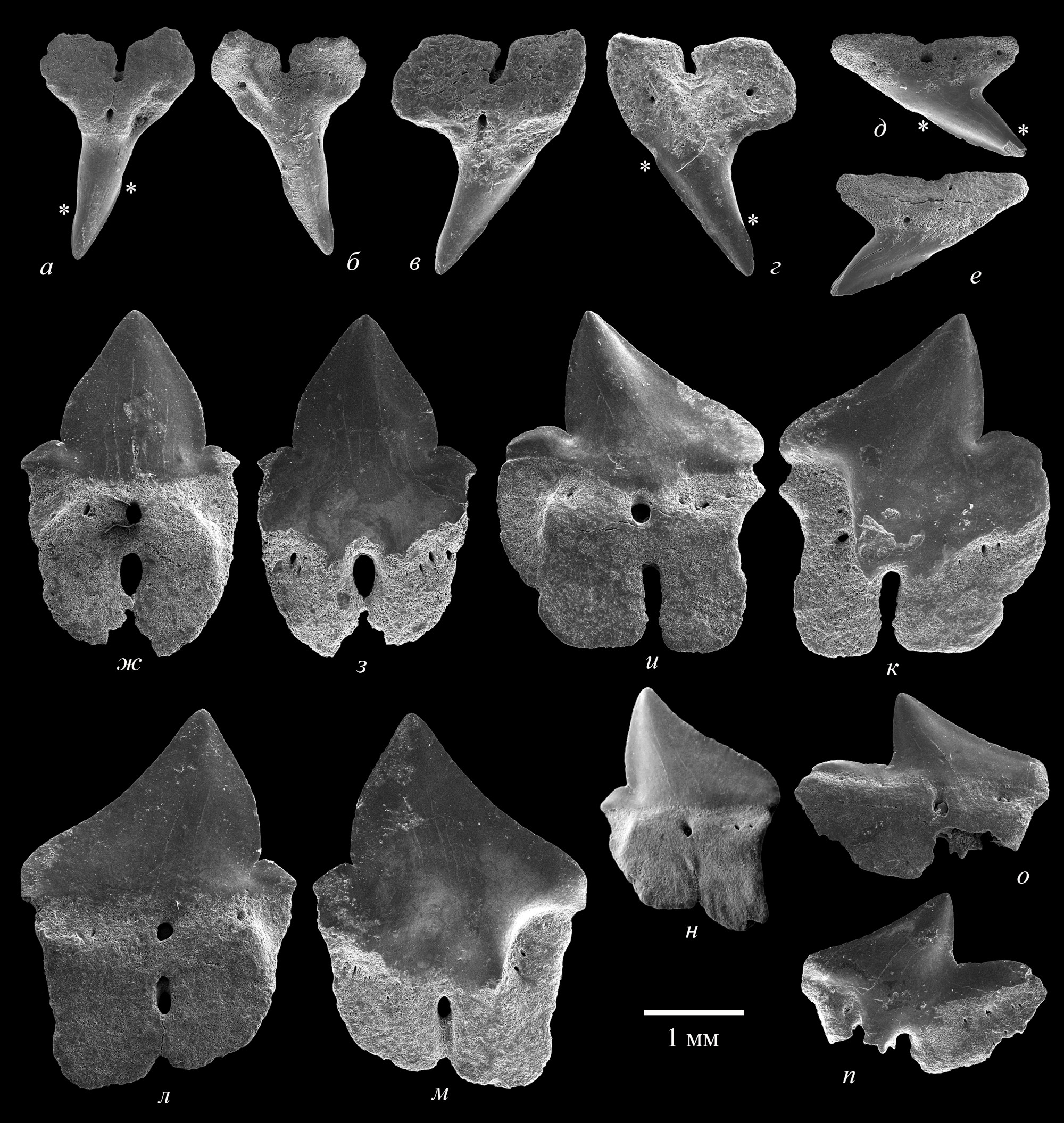
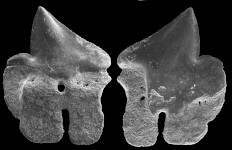
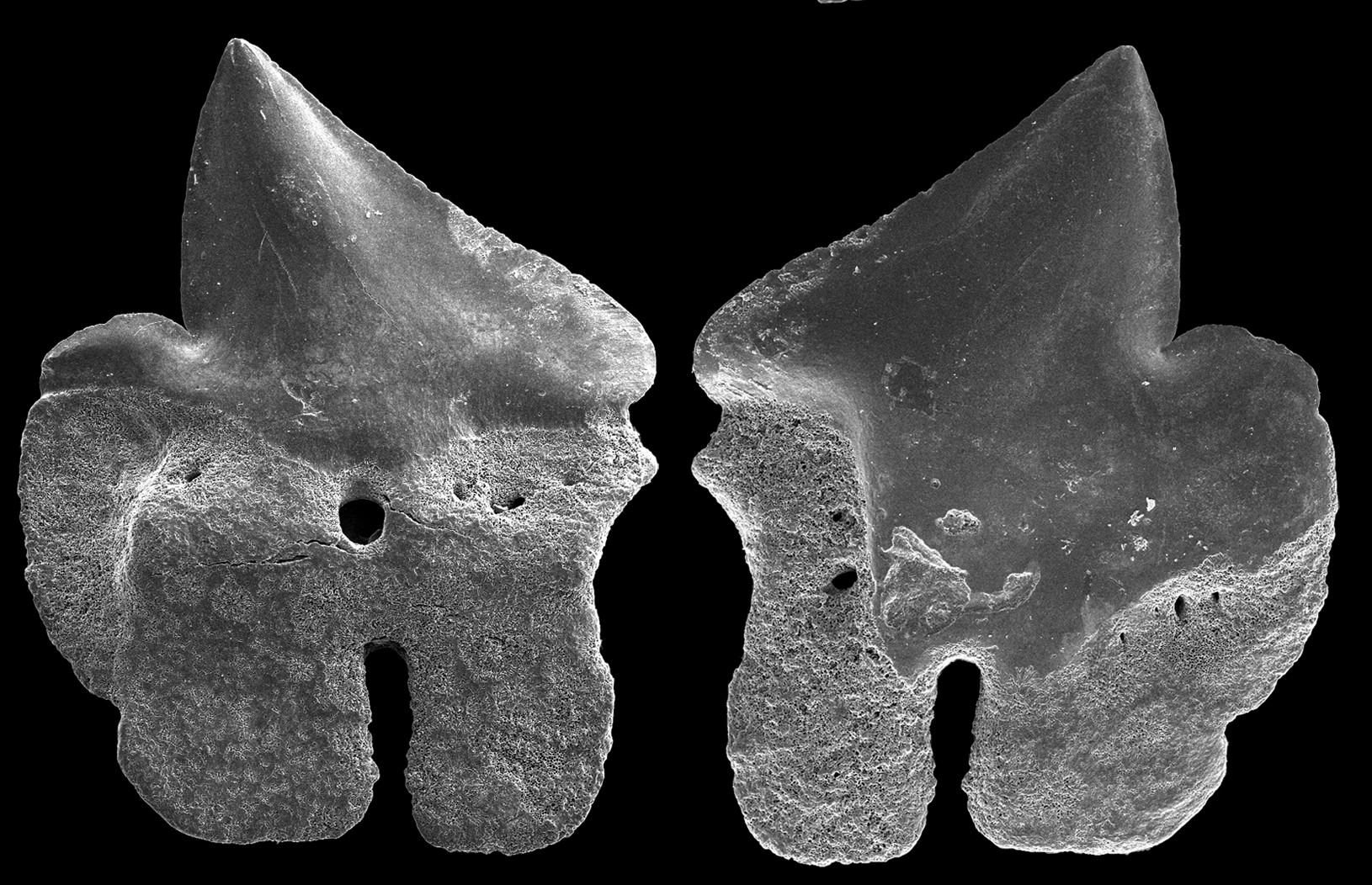
Danodalatias ochevi Popov, Lopyrev & Yarkov, 2024, Volgograd Region, Dubovka District, farmstead of Rasstrigin, Rasstrigin-2, Lower Paleocene, Danian, Berezovaya Strata, interval of 3–4 m above the basal horizon © E. V. Popov
Danodalatias ochevi Popov, Lopyrev & Yarkov, 2024, Volgograd Region, Dubovka District, farmstead of Rasstrigin, Rasstrigin-2, Lower Paleocene, Danian, Berezovaya Strata, interval of 3–4 m above the basal horizon © E. V. Popov
Description
Original diagnosis after Popov, Lopyrev & Yarko, 2024 [33563]: (based on the dental system). The fossil genus of Dalatiidae has awl-shaped upper teeth and wide labiolingually compressed cutting lower teeth; there is a file of symmetrical symphyseal lower teeth. Upper teeth, known only for the type species, are relatively large, up to 2.5 mm high. Crowns are straight or distally curved. The cutting edge is well developed. The distal cutting edge occupies the upper third of the crown height and the mesial edge occupies the apical half of the crown height in anterior teeth and almost the entire height in teeth positioned more laterally. The heel of the crown is indistinct. The apron on the anterior and adjacent lateral teeth is divided into two lobes extending medio- and distobasally from the middle part of the tooth; it is indistinct on the posterolateral teeth. The basal notch of the root is relatively deep and narrow; the central foramen opens into it; the notch is weakly defined only on the posterolateral teeth and the central foramen is located labially under the base of the crown. The lobes of the root are close to rectangular. The lingual protuberance of the root is moderately developed; its upper part contains a medio-lingual foramen. There are labial and lingual marginal foramina on both the mesial and distal lobes of the root; the labial foramina are usually better developed.
Lower teeth are up to 12 mm high, with low crowns and moderately or strongly overlapping teeth. Crowns are straight or slightly inclined distally, asymmetrical in the anterior and lateral teeth and symmetrical in the symphyseal teeth, and nonserrated or weakly, irregularly serrated along one or both cutting edges. The mesial cutting edge of the crown is concave and the distal one is convex; in symphyseal teeth, both cutting edges are convex. The heel of the crown is on the distal side of the tooth. The apron is very wide and flattened; its lower edge is relatively poorly developed and slightly covers or does not cover the button-hole of the root. The basal notch of the root is either relatively deep and narrow and reaches the button-hole, or shallow; it is connected to the button-hole by the median labial hollow. The central foramen opens in the button- hole. There are a well-developed medio-lingual foramen on the lingual side and more or less developed labial and lingual marginal foramina on the mesial and distal lobes of the root. The basal edge of the crown is straight or slightly curved on the lingual side.
Original diagnosis after Popov, Lopyrev & Yarko, 2024 [33563]: (based on the dental system). The fossil genus of Dalatiidae has awl-shaped upper teeth and wide labiolingually compressed cutting lower teeth; there is a file of symmetrical symphyseal lower teeth. Upper teeth, known only for the type species, are relatively large, up to 2.5 mm high. Crowns are straight or distally curved. The cutting edge is well developed. The distal cutting edge occupies the upper third of the crown height and the mesial edge occupies the apical half of the crown height in anterior teeth and almost the entire height in teeth positioned more laterally. The heel of the crown is indistinct. The apron on the anterior and adjacent lateral teeth is divided into two lobes extending medio- and distobasally from the middle part of the tooth; it is indistinct on the posterolateral teeth. The basal notch of the root is relatively deep and narrow; the central foramen opens into it; the notch is weakly defined only on the posterolateral teeth and the central foramen is located labially under the base of the crown. The lobes of the root are close to rectangular. The lingual protuberance of the root is moderately developed; its upper part contains a medio-lingual foramen. There are labial and lingual marginal foramina on both the mesial and distal lobes of the root; the labial foramina are usually better developed.
Lower teeth are up to 12 mm high, with low crowns and moderately or strongly overlapping teeth. Crowns are straight or slightly inclined distally, asymmetrical in the anterior and lateral teeth and symmetrical in the symphyseal teeth, and nonserrated or weakly, irregularly serrated along one or both cutting edges. The mesial cutting edge of the crown is concave and the distal one is convex; in symphyseal teeth, both cutting edges are convex. The heel of the crown is on the distal side of the tooth. The apron is very wide and flattened; its lower edge is relatively poorly developed and slightly covers or does not cover the button-hole of the root. The basal notch of the root is either relatively deep and narrow and reaches the button-hole, or shallow; it is connected to the button-hole by the median labial hollow. The central foramen opens in the button- hole. There are a well-developed medio-lingual foramen on the lingual side and more or less developed labial and lingual marginal foramina on the mesial and distal lobes of the root. The basal edge of the crown is straight or slightly curved on the lingual side.
Remarks
shark-references Species-ID=17445;
type species of Danodalatias Popov & Lopyrev & Yarkov, 2024 [33563] by original designation (Art. 68.2 ICZN);
shark-references Species-ID=17445;
type species of Danodalatias Popov & Lopyrev & Yarkov, 2024 [33563] by original designation (Art. 68.2 ICZN);
References

A New Genus of Kitefin Sharks (Squaliformes, Dalatiidae) from the Berezovaya Strata (Lower Paleocene) of the Lower Volga Region. Paleontological Journal, 58, 556–566
DOI: 10.1134/S0031030124600720
A New Genus of Kitefin Sharks (Squaliformes, Dalatiidae) from the Berezovaya Strata (Lower Paleocene) of the Lower Volga Region. Paleontological Journal, 58, 556–566
DOI: 10.1134/S0031030124600720