


 Catalog of Fishes
 literature references
 FishBase
 NCBI GenBank
Himantura arlyzae
Borsa, Hernawan, Hocdé & Pouyaud, 2026
Classification: Elasmobranchii Myliobatiformes Dasyatidae
Reference of the original description
Molecular diagnosis and geographic distribution of species in the endangered whipray genus Himantura, with description of a new species from the Indo-Malay archipelago. Aquatic Living Resources, 39, Article 28
Molecular diagnosis and geographic distribution of species in the endangered whipray genus Himantura, with description of a new species from the Indo-Malay archipelago. Aquatic Living Resources, 39, Article 28
Images of types
Description :
Citation: Himantura arlyzae Borsa, Hernawan, Hocdé & Pouyaud, 2026: In: Database of modern sharks, rays and chimaeras, www.shark-references.com, World Wide Web electronic publication, Version 10/2026
Please send your images of "Himantura arlyzae" to info@shark-references.com
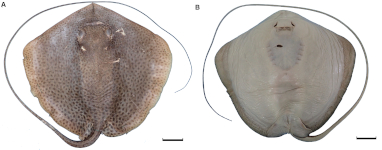
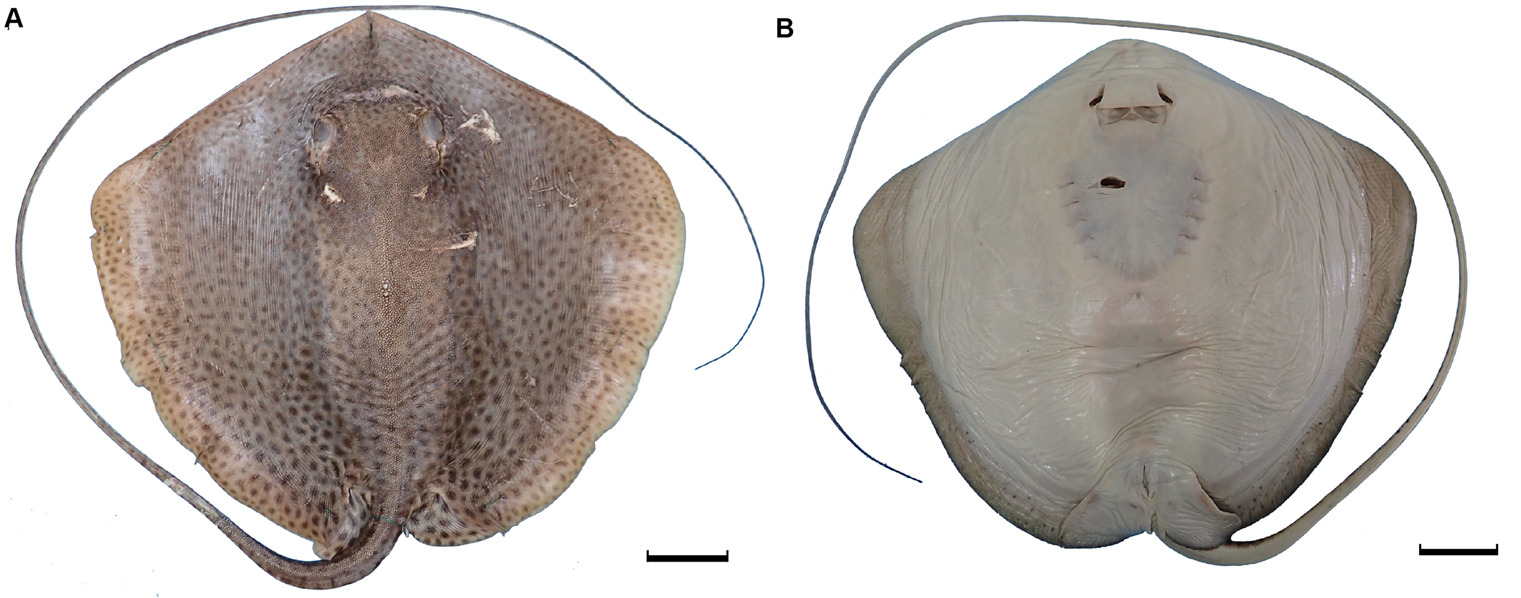
Himantura arlyzae Borsa, Hernawan, Hocdé & Pouyaud, 2026; holotype no. MZB-20875 © Borsa, Hernawan, Hocdé & Pouyaud, 2026
Himantura arlyzae Borsa, Hernawan, Hocdé & Pouyaud, 2026; holotype no. MZB-20875 © Borsa, Hernawan, Hocdé & Pouyaud, 2026
Short Description
Diagnosis after Borsa, Hernawan, Hocdé & Pouyaud, 2026 [36306]: Based on the alignment of 249 partial CO1-gene sequences (Fig. 2), H. arlyzae sp. nov. (N=35) differs from all other species in the genus Himantura that were sequenced at the CO1 locus (except Himantura sp. 2), by possessing the following private nucleotides: T at nucleotide site no. 192 and G at nucleotide sites nos. 249 and 576 of the gene. In addition, H. arlyzae sp. nov. differs from Himantura sp. 2 (N=2) by possessing nucleotide A (instead of G) at site no. 111 and nucleotide G (instead of A) at site no. 363. Based on allelic frequencies at five intron loci (Tab. 3), H. arlyzae sp. nov. individuals (N=23) differ from H. leoparda (N=57) by possessing size allele 186 (vs. allele 190) at actin intron locus Act-2 A; and by possessing allele 125 (vs. alleles 129 and 144) at calmodulin intron locus Cam-3 C. Also, while H. arlyzae sp. nov. individuals (N=23) are all homozygous for allele 165 at locus Cam-3 B and allele 125 at locus Cam-3 C, the probability of encountering an H. tutul individual homozygous for these two alleles is approximately 0.1% (based on a sample of 28 individuals, assuming Hardy-Weiberg equilibrium at both loci, and assuming the latter are independent).
Diagnosis after Borsa, Hernawan, Hocdé & Pouyaud, 2026 [36306]: Based on the alignment of 249 partial CO1-gene sequences (Fig. 2), H. arlyzae sp. nov. (N=35) differs from all other species in the genus Himantura that were sequenced at the CO1 locus (except Himantura sp. 2), by possessing the following private nucleotides: T at nucleotide site no. 192 and G at nucleotide sites nos. 249 and 576 of the gene. In addition, H. arlyzae sp. nov. differs from Himantura sp. 2 (N=2) by possessing nucleotide A (instead of G) at site no. 111 and nucleotide G (instead of A) at site no. 363. Based on allelic frequencies at five intron loci (Tab. 3), H. arlyzae sp. nov. individuals (N=23) differ from H. leoparda (N=57) by possessing size allele 186 (vs. allele 190) at actin intron locus Act-2 A; and by possessing allele 125 (vs. alleles 129 and 144) at calmodulin intron locus Cam-3 C. Also, while H. arlyzae sp. nov. individuals (N=23) are all homozygous for allele 165 at locus Cam-3 B and allele 125 at locus Cam-3 C, the probability of encountering an H. tutul individual homozygous for these two alleles is approximately 0.1% (based on a sample of 28 individuals, assuming Hardy-Weiberg equilibrium at both loci, and assuming the latter are independent).
Distribution
part of the Indo-Malay archipelago including the South China Sea, the Sulu Sea, the Philippine Sea, Makassar Strait, the Bali Sea, the Flores Sea and the Banda Sea [36306]
part of the Indo-Malay archipelago including the South China Sea, the Sulu Sea, the Philippine Sea, Makassar Strait, the Bali Sea, the Flores Sea and the Banda Sea [36306]
Remarks
shark-references Species-ID=17878
shark-references Species-ID=17878