


 Catalog of Fishes
 literature references
 FishBase
 NCBI GenBank
Paratrygon munduruku
Loboda, 2026
Classification: Elasmobranchii Myliobatiformes Potamotrygonidae
Reference of the original description
Four new species of neotropical freshwater stingrays of the genus Paratrygon (Myliobatiformes: Potamotrygonidae) from clear water rivers of the Amazon basin. Neotropical Ichthyology, 24(1), Article e250087
Four new species of neotropical freshwater stingrays of the genus Paratrygon (Myliobatiformes: Potamotrygonidae) from clear water rivers of the Amazon basin. Neotropical Ichthyology, 24(1), Article e250087
Types
Paratrygon munduruku
Holotype: MZUSP: 103916; Paratype: INPA: 6884; MZUSP: 10288; MZUSP: 103917;
Paratrygon munduruku
Holotype: MZUSP: 103916; Paratype: INPA: 6884; MZUSP: 10288; MZUSP: 103917;
Description :
Citation: Paratrygon munduruku Loboda, 2026: In: Database of modern sharks, rays and chimaeras, www.shark-references.com, World Wide Web electronic publication, Version 10/2026
Please send your images of "Paratrygon munduruku" to info@shark-references.com
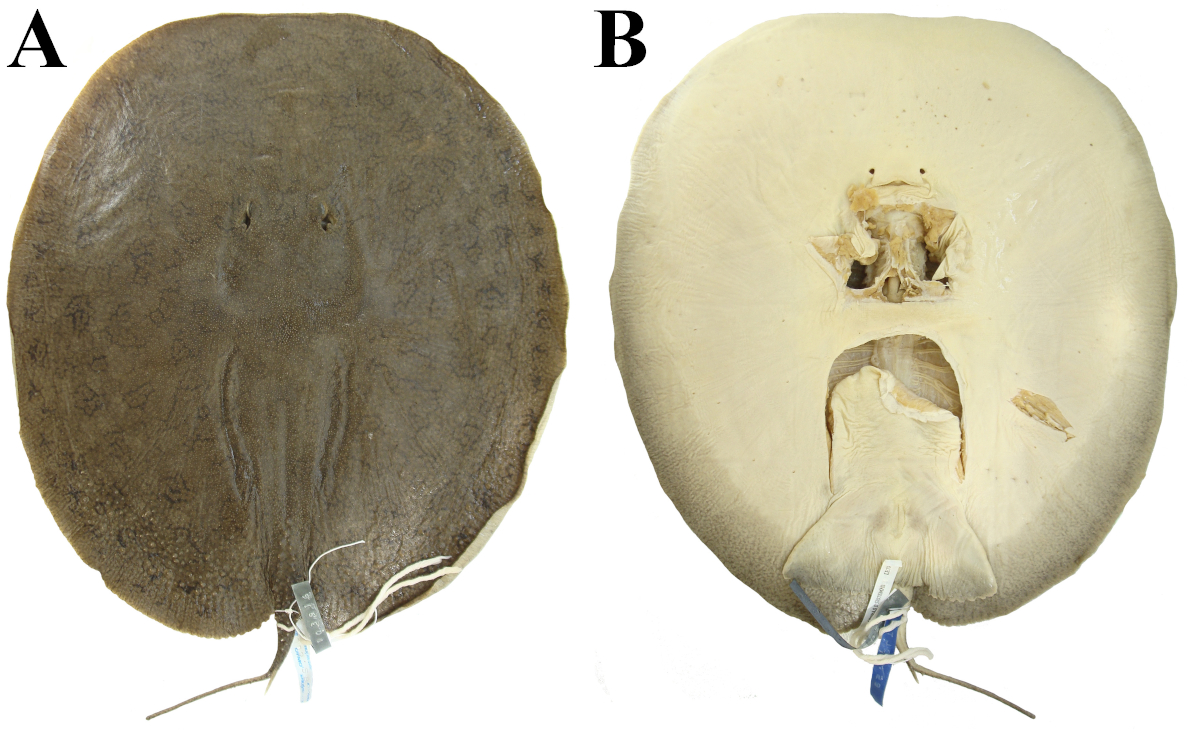
Paratrygon munduruku Loboda, 2026; holotype, MZUSP 103916, juvenile female, 315 mm DW, from Tapajós River. A. Dorsal; B. Ventral views. © Loboda, 2026
Paratrygon munduruku Loboda, 2026; holotype, MZUSP 103916, juvenile female, 315 mm DW, from Tapajós River. A. Dorsal; B. Ventral views. © Loboda, 2026
Short Description
Diagnosis after Loboda, 2026 [35912]: Paratrygon munduruku is diagnosed by the following combination of characters: the dorsal coloration of the disc is brown with numerous small, dark brown spots in axon or vermiculated formats spread throughout the disc, not very conspicous and lacking withish withish spots (vs. P. aiereba, P. orinocensis, P. parvaspina which have gray or light brown coloration with apparent dark spots; P. lucindai, which has dorsal coloration in gray, dark gray, brown and dark brown with large, rounded dark spots throughout throughout the disc; P. araguaia with a brown or dark brown dorsal disc presenting two types of spots scattered throughout the disc, with one type light, big, rounded and evident in beige or light brown, and the other type dark, small, and vermiculated, occurring between light spots; P. raonii witha very dark coloration in dark brown and black tonalities and possessing very dark, evident, black spots in vermicular or dendritic format); small and quadrangular spiracle with a mean spiracle length of 4.6% DW (3.6–5.8% DW), with a reduced, rounded spiracular process that covers only a small part of the posterior portion of the spiracular aperture [vs. P. orinocensis with triangular spiracles; P. lucindai, P. araguaia with rounded spiracles; P. aiereba with quadrangular and large spiracles, and mean spiracle lenght of 6% DW (4.4–11.6% DW); P. parvaspina with quadrangular and small spiracle and an extremely reduced spiracular process; P. raonii with quadrangular and small spiracle and a developed, globular spiracular process]; dermal denticles on the central disc with a crown that possesses a central coronal plate and lateral coronal ridges in a leaf shape, with the lateral coronal ridges smaller and ranging from two (vs. P. aiereba which has a crown of central dermal denticles with pointed central coronal plates and pointed to slightly rounded lateral coronal ridges ranging from three to six; P. parvaspina with a crown of central dermal denticles with central coronal plates and pointed lateral coronal ridges, with a few ridges, between two and four; P. lucindai with a crown of central dermal denticles that possess a quadrangular central coronal plate and slightly round lateral coronal ridges, with three to six ridges; P. orinocensis and P. raonii, which have well developed, pointed lateral coronal ridges, more than twelve in P. orinocensis, and six to eight in P. raonii; P. araguaia, which has central dermal denticles that present a pointed and reduced central coronal plate and rounded, well developed lateral coronal ridges); the propterygium is arched and stout, with the posterior portion thicker than the anterior (vs. P. aiereba, P. araguaia, and P. raonii, which have a straight and slender propterygium; P. orinocensis has an arched propterygium, but its is thinner; P. parvaspina which has an arched and thicker propterygium with a thicker anterior portion than P. munduruku; P. lucindai, which has an arched and stout propterygium that is more arched than that of P. munduruku).
Diagnosis after Loboda, 2026 [35912]: Paratrygon munduruku is diagnosed by the following combination of characters: the dorsal coloration of the disc is brown with numerous small, dark brown spots in axon or vermiculated formats spread throughout the disc, not very conspicous and lacking withish withish spots (vs. P. aiereba, P. orinocensis, P. parvaspina which have gray or light brown coloration with apparent dark spots; P. lucindai, which has dorsal coloration in gray, dark gray, brown and dark brown with large, rounded dark spots throughout throughout the disc; P. araguaia with a brown or dark brown dorsal disc presenting two types of spots scattered throughout the disc, with one type light, big, rounded and evident in beige or light brown, and the other type dark, small, and vermiculated, occurring between light spots; P. raonii witha very dark coloration in dark brown and black tonalities and possessing very dark, evident, black spots in vermicular or dendritic format); small and quadrangular spiracle with a mean spiracle length of 4.6% DW (3.6–5.8% DW), with a reduced, rounded spiracular process that covers only a small part of the posterior portion of the spiracular aperture [vs. P. orinocensis with triangular spiracles; P. lucindai, P. araguaia with rounded spiracles; P. aiereba with quadrangular and large spiracles, and mean spiracle lenght of 6% DW (4.4–11.6% DW); P. parvaspina with quadrangular and small spiracle and an extremely reduced spiracular process; P. raonii with quadrangular and small spiracle and a developed, globular spiracular process]; dermal denticles on the central disc with a crown that possesses a central coronal plate and lateral coronal ridges in a leaf shape, with the lateral coronal ridges smaller and ranging from two (vs. P. aiereba which has a crown of central dermal denticles with pointed central coronal plates and pointed to slightly rounded lateral coronal ridges ranging from three to six; P. parvaspina with a crown of central dermal denticles with central coronal plates and pointed lateral coronal ridges, with a few ridges, between two and four; P. lucindai with a crown of central dermal denticles that possess a quadrangular central coronal plate and slightly round lateral coronal ridges, with three to six ridges; P. orinocensis and P. raonii, which have well developed, pointed lateral coronal ridges, more than twelve in P. orinocensis, and six to eight in P. raonii; P. araguaia, which has central dermal denticles that present a pointed and reduced central coronal plate and rounded, well developed lateral coronal ridges); the propterygium is arched and stout, with the posterior portion thicker than the anterior (vs. P. aiereba, P. araguaia, and P. raonii, which have a straight and slender propterygium; P. orinocensis has an arched propterygium, but its is thinner; P. parvaspina which has an arched and thicker propterygium with a thicker anterior portion than P. munduruku; P. lucindai, which has an arched and stout propterygium that is more arched than that of P. munduruku).
Dentition
Larger teeth, in quincunx in both jaws and without size difference between teeth from central to lateral rows (Fig. 33). Number of teeth in both jaws 17/15 of paratype MZUSP 10288 (Tab. 6). Teeth from central rows more triangular in shape, and with more prominent cusps. [35912]
Larger teeth, in quincunx in both jaws and without size difference between teeth from central to lateral rows (Fig. 33). Number of teeth in both jaws 17/15 of paratype MZUSP 10288 (Tab. 6). Teeth from central rows more triangular in shape, and with more prominent cusps. [35912]
Remarks
shark-references Species-ID=17811
shark-references Species-ID=17811