


 Catalog of Fishes
 literature references
 FishBase
 NCBI GenBank
Potamotrygon siponinmorok
Hemraj-Naraine, Fontenelle, Acosta-Santos, Lovejoy, Liverpool & Kolmann, 2026
Classification: Elasmobranchii Myliobatiformes Potamotrygonidae
Reference of the original description
A new species of freshwater stingray (Myliobatiformes: Potamotrygoninae) from northern South America. Neotropical Ichthyology, 24(1), Article e250178
A new species of freshwater stingray (Myliobatiformes: Potamotrygoninae) from northern South America. Neotropical Ichthyology, 24(1), Article e250178
Types
Potamotrygon siponinmorok
Holotype: CSBD: F3620 (olim ROM 100073-T20846); Paratype: ROM: 103015c-NL10112; ROM: 100073-20849; ROM: 103015b-NL10108; ROM: 100992-20688; ROM: 103015-NL10110; ROM: 100073-20848; ROM: 103015d-NL10109; ROM: 103015e-NL10113; ROM: 100073-20847; ROM: T8998/AUM53789;
Potamotrygon siponinmorok
Holotype: CSBD: F3620 (olim ROM 100073-T20846); Paratype: ROM: 103015c-NL10112; ROM: 100073-20849; ROM: 103015b-NL10108; ROM: 100992-20688; ROM: 103015-NL10110; ROM: 100073-20848; ROM: 103015d-NL10109; ROM: 103015e-NL10113; ROM: 100073-20847; ROM: T8998/AUM53789;
Description :
Citation: Potamotrygon siponinmorok Hemraj-Naraine, Fontenelle, Acosta-Santos, Lovejoy, Liverpool & Kolmann, 2026: In: Database of modern sharks, rays and chimaeras, www.shark-references.com, World Wide Web electronic publication, Version 10/2026
Please send your images of "Potamotrygon siponinmorok" to info@shark-references.com
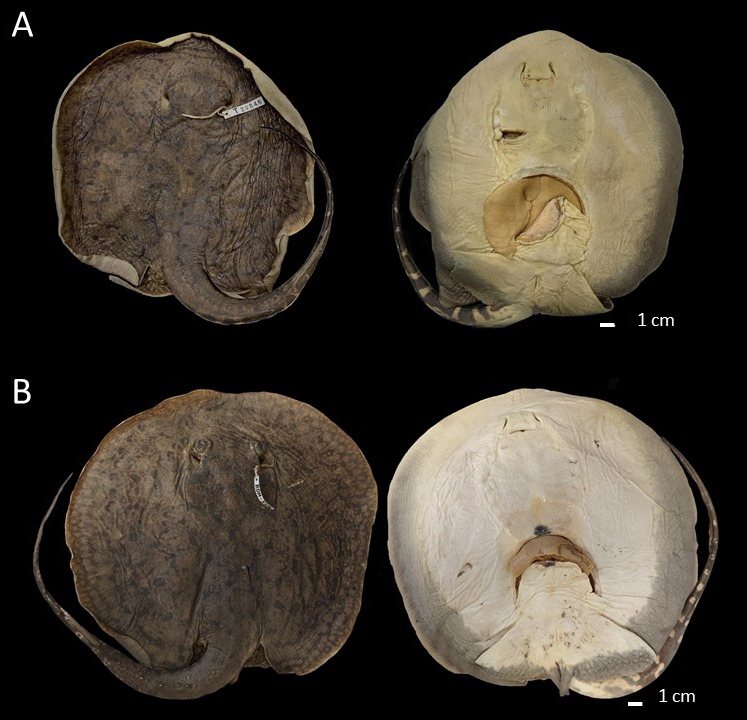
Potamotrygon siponinmorok Hemraj-Naraine, Fontenelle, Acosta-Santos, Lovejoy, Liverpool & Kolmann, 2026; holotype, CSBD F3620 (juvenile male, 224 mm DW), dorsal and ventral view. B. paratype, ROM 100073-20848 (juvenile male, 272 mm DW), dorsal and ventral view. © Hemraj-Naraine et al. 2026
Potamotrygon siponinmorok Hemraj-Naraine, Fontenelle, Acosta-Santos, Lovejoy, Liverpool & Kolmann, 2026; holotype, CSBD F3620 (juvenile male, 224 mm DW), dorsal and ventral view. B. paratype, ROM 100073-20848 (juvenile male, 272 mm DW), dorsal and ventral view. © Hemraj-Naraine et al. 2026
Short Description
Diagnosis after Hemraj-Naraine, Fontenelle, Acosta-Santos, Lovejoy, Liverpool & Kolmann, 2026 [35911]: Potamotrygon siponinmorok is distinguished from sympatric congeners, except for polymorphic P. orbignyi (see da Silva, 2010), by its coloration consisting of dorsal disk dark brown, medial region with small light brown rosettes joined to form a hexagonal pattern from interorbital region to tail base (vs. dark brown background with orange-red ocellated spots irregular in shape, surrounded by broad concentric black rings in P. boesemani, dark brown background with light spots about twice orbit size, formed by clusters of ~50 smaller spots in P. marinae, black background with tan, beige, golden yellow, or orangish rosettes in P. schroederi, and graybrown background with conspicuous tricolored ocelli: central yellow spot, intermediate orange ring, external black ring in P. motoro; Fig. 4). Potamotrygon siponinmorok is distinguished from P. orbignyi by the labial ridges present at the corners of the lower jaw but weakly developed and not distinctly demarcated (vs. well-developed labial groove), 28 and 35 upper and lower tooth rows, respectively (vs. 35 and 33), teeth blunt and smooth (vs. with triangular crowns, slightly monocuspid in males or trapezoidal and tricuspid in females, see da Silva, Carvalho, 2015), lateral line with a bridge connecting the suborbital loop and infraorbital loop (vs. bridge absent), hyomadibular cartilage thick with curved ends (vs. slender and straight ends), posterior subpleural tubules are absent (vs. present), and total number of vertebrae 131 (vs. 125). Potamotrygon siponinmorok is further distinguished from congeners by a dark pigmented crescent-shaped blotch positioned dorsal and posterior to spiracle (vs. absent in all sympatric congeners), by its ventral surface tan/beige with the posterior margin of the disk gray (vs. black posterior margin in P. boesemani and dark gray covering the entire surface except the oral cavity in P. marinae), by the tail ventral surface displaying beige to light brown bands originating from its the lateral sides, and alternating with dark brown bands (the beige bands remain disconnected while the brown bands connect across the ventral midline) (vs. completely black ventral tail in P. boesemani and reticulated brown pattern in P. motoro), tail relatively long, with a tail length of 120.7% DW (vs. 83.9% DW in P. marinae and 92% DW in P. orbignyi), tail denticles large and arranged in a single row from the base of the tail to the insertion of the stinger (vs. no regular order in P. motoro; four rows in P. schroederi; and no or small spines in P. orbignyi), a larger number of denticles concentrated in the center of the dorsal disk (vs. denticles covering the entire dorsal disk in P. motoro), the tail denticles having a rounded base (vs. stellate base in P. marinae), and by having a single, long angular cartilage (vs. two smaller angular cartilages in P. motoro and P. boesemani).
Diagnosis after Hemraj-Naraine, Fontenelle, Acosta-Santos, Lovejoy, Liverpool & Kolmann, 2026 [35911]: Potamotrygon siponinmorok is distinguished from sympatric congeners, except for polymorphic P. orbignyi (see da Silva, 2010), by its coloration consisting of dorsal disk dark brown, medial region with small light brown rosettes joined to form a hexagonal pattern from interorbital region to tail base (vs. dark brown background with orange-red ocellated spots irregular in shape, surrounded by broad concentric black rings in P. boesemani, dark brown background with light spots about twice orbit size, formed by clusters of ~50 smaller spots in P. marinae, black background with tan, beige, golden yellow, or orangish rosettes in P. schroederi, and graybrown background with conspicuous tricolored ocelli: central yellow spot, intermediate orange ring, external black ring in P. motoro; Fig. 4). Potamotrygon siponinmorok is distinguished from P. orbignyi by the labial ridges present at the corners of the lower jaw but weakly developed and not distinctly demarcated (vs. well-developed labial groove), 28 and 35 upper and lower tooth rows, respectively (vs. 35 and 33), teeth blunt and smooth (vs. with triangular crowns, slightly monocuspid in males or trapezoidal and tricuspid in females, see da Silva, Carvalho, 2015), lateral line with a bridge connecting the suborbital loop and infraorbital loop (vs. bridge absent), hyomadibular cartilage thick with curved ends (vs. slender and straight ends), posterior subpleural tubules are absent (vs. present), and total number of vertebrae 131 (vs. 125). Potamotrygon siponinmorok is further distinguished from congeners by a dark pigmented crescent-shaped blotch positioned dorsal and posterior to spiracle (vs. absent in all sympatric congeners), by its ventral surface tan/beige with the posterior margin of the disk gray (vs. black posterior margin in P. boesemani and dark gray covering the entire surface except the oral cavity in P. marinae), by the tail ventral surface displaying beige to light brown bands originating from its the lateral sides, and alternating with dark brown bands (the beige bands remain disconnected while the brown bands connect across the ventral midline) (vs. completely black ventral tail in P. boesemani and reticulated brown pattern in P. motoro), tail relatively long, with a tail length of 120.7% DW (vs. 83.9% DW in P. marinae and 92% DW in P. orbignyi), tail denticles large and arranged in a single row from the base of the tail to the insertion of the stinger (vs. no regular order in P. motoro; four rows in P. schroederi; and no or small spines in P. orbignyi), a larger number of denticles concentrated in the center of the dorsal disk (vs. denticles covering the entire dorsal disk in P. motoro), the tail denticles having a rounded base (vs. stellate base in P. marinae), and by having a single, long angular cartilage (vs. two smaller angular cartilages in P. motoro and P. boesemani).
Distribution
Demerara River, Region 4 (Demerara-Mahaica), Guyana near the capital Georgetown and río Guanare, Orinoco drainage, Venezuela [35911]
Demerara River, Region 4 (Demerara-Mahaica), Guyana near the capital Georgetown and río Guanare, Orinoco drainage, Venezuela [35911]
Dentition
Teeth are ovoid, blunted, and smooth, and are arranged in a quincunx (five teeth with four forming the corners of a square and the fifth at its center) pattern (observation is seen more predominantly at the center of the tooth plate). Both jaws have teeth, with medial and lateral teeth identical in size; teeth of medial rows with more developed cusps than lateral teeth (Fig. 9B). Upper tooth row of teeth in holotype is 28 and lower tooth row is 35. Rows of teeth count were done following Rosa (1985) [35911]
Teeth are ovoid, blunted, and smooth, and are arranged in a quincunx (five teeth with four forming the corners of a square and the fifth at its center) pattern (observation is seen more predominantly at the center of the tooth plate). Both jaws have teeth, with medial and lateral teeth identical in size; teeth of medial rows with more developed cusps than lateral teeth (Fig. 9B). Upper tooth row of teeth in holotype is 28 and lower tooth row is 35. Rows of teeth count were done following Rosa (1985) [35911]
Remarks
shark-references Species-ID=17808
shark-references Species-ID=17808