


Protocentrophorus steviae
Cappetta, Morrison & Adnet, 2019
Classification: Elasmobranchii Squaliformes Centrophoridae
Reference of the original description
A shark fauna from the Campanian of Hornby Island, British Columbia, Canada: an insight into the diversity of Cretaceous deep-water assemblages. Historical Biology, 33(8), 1121–1182
A shark fauna from the Campanian of Hornby Island, British Columbia, Canada: an insight into the diversity of Cretaceous deep-water assemblages. Historical Biology, 33(8), 1121–1182
Types
Protocentrophorus steviae
Holotype: RBCM: P1235; Paratype: RBCM: P1306; RBCM: P1307; RBCM: P1239;
Protocentrophorus steviae
Holotype: RBCM: P1235; Paratype: RBCM: P1306; RBCM: P1307; RBCM: P1239;
Description:
Citation: Protocentrophorus steviae Cappetta, Morrison & Adnet, 2019: In: Database of fossil elasmobranch teeth www.shark-references.com, World Wide Web electronic publication, Version 10/2026
Please send your images of "Protocentrophorus steviae" to info@shark-references.com
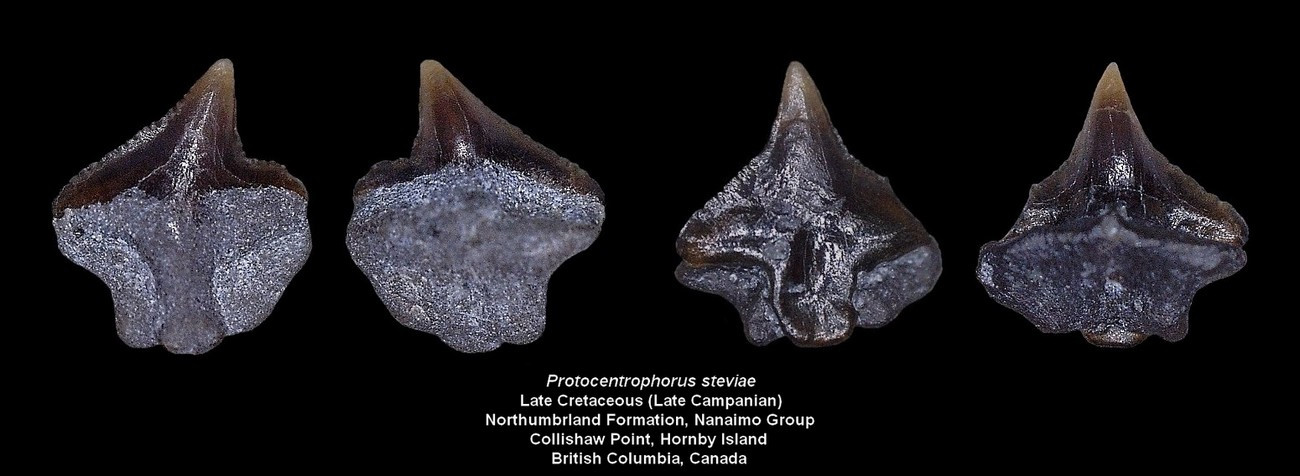
Protocentrophorus steviae Cappetta, Morrison & Adnet, 2019, Late Cretaceous, Late Campanian, Northumberland Formation, Nanalmo Group, Collishaw Point, Hornby Island, Canada, collection and © Adam Anderson
Protocentrophorus steviae Cappetta, Morrison & Adnet, 2019, Late Cretaceous, Late Campanian, Northumberland Formation, Nanalmo Group, Collishaw Point, Hornby Island, Canada, collection and © Adam Anderson
Description
Original diagnosis after Cappetta, Morrison & Adnet, 2019 [27810]: This new species is characterised by a combination of the following morphologies: Lower anterior teeth are higher than wide, with a distally bent triangular cusp. The mesial cutting edge is smooth or slightly serrated rather rectilinear overall, but with a slight gibbosity before the apical section of the cusp. The apron in labial view is moderately long and wide with an enlarged rounded extremity overhanging the edge of the root. The triangular uvula is not very high with a depressed upper face. Mesial limit of the root with a well-marked concavity regularly angular in anterior teeth and rounded in lateral teeth. In lingual view, root with a strong transverse lingual protuberance and an elliptical infundibulum.
Upper anterior teeth almost symmetrical, much higher than broad, with an erect triangular cusp and oblique lateral heels. Cutting edges smooth. Stout median apron with an enlarged extremity overhanging a broad median notch of the root. Basal face of the root bearing a central foramen aligning with another foramen opening in the middle of the lingual protuberance, which is arched. The large but narrow uvula in anterior teeth becomes narrower and higher in the lateral files.
P. steviae separates from P. balticus by a thicker, more salient and more vertical apron, whereas, in P. balticus, its extremity is distally turning. Infundibulum well differentiated compared to P. balticus. The extremity of apron overhangs the basal notch of the root, a character less marked in P. balticus. In upper teeth, the medio-lingual and central (or medio-labial) foramina are not fused into an infundibulum.
Original diagnosis after Cappetta, Morrison & Adnet, 2019 [27810]: This new species is characterised by a combination of the following morphologies: Lower anterior teeth are higher than wide, with a distally bent triangular cusp. The mesial cutting edge is smooth or slightly serrated rather rectilinear overall, but with a slight gibbosity before the apical section of the cusp. The apron in labial view is moderately long and wide with an enlarged rounded extremity overhanging the edge of the root. The triangular uvula is not very high with a depressed upper face. Mesial limit of the root with a well-marked concavity regularly angular in anterior teeth and rounded in lateral teeth. In lingual view, root with a strong transverse lingual protuberance and an elliptical infundibulum.
Upper anterior teeth almost symmetrical, much higher than broad, with an erect triangular cusp and oblique lateral heels. Cutting edges smooth. Stout median apron with an enlarged extremity overhanging a broad median notch of the root. Basal face of the root bearing a central foramen aligning with another foramen opening in the middle of the lingual protuberance, which is arched. The large but narrow uvula in anterior teeth becomes narrower and higher in the lateral files.
P. steviae separates from P. balticus by a thicker, more salient and more vertical apron, whereas, in P. balticus, its extremity is distally turning. Infundibulum well differentiated compared to P. balticus. The extremity of apron overhangs the basal notch of the root, a character less marked in P. balticus. In upper teeth, the medio-lingual and central (or medio-labial) foramina are not fused into an infundibulum.
References

Bioluminescence and repeated deep-sea colonization shaped the diversification and body size evolution of squaliform sharks. Proceedings of the Royal Society B-Biological Sciences, 292(2042), Article 20242932
DOI: 10.1098/rspb.2024.2932
Global impact and selectivity of the Cretaceous-Paleogene mass extinction among sharks, skates, and rays. Science, 379, 802–806
DOI: 10.1126/science.abn2080
A shark fauna from the Campanian of Hornby Island, British Columbia, Canada: an insight into the diversity of Cretaceous deep-water assemblages. Historical Biology, 33(8), 1121–1182
DOI: 10.1080/08912963.2019.1681421
Late Cretaceous fish fossils from Nemuro Municipality, Hokkaido, Japan. [in Japanese, with English summary] Memoirs of the National Science Museum, 26, 39–46
Bioluminescence and repeated deep-sea colonization shaped the diversification and body size evolution of squaliform sharks. Proceedings of the Royal Society B-Biological Sciences, 292(2042), Article 20242932
DOI: 10.1098/rspb.2024.2932
Global impact and selectivity of the Cretaceous-Paleogene mass extinction among sharks, skates, and rays. Science, 379, 802–806
DOI: 10.1126/science.abn2080
A shark fauna from the Campanian of Hornby Island, British Columbia, Canada: an insight into the diversity of Cretaceous deep-water assemblages. Historical Biology, 33(8), 1121–1182
DOI: 10.1080/08912963.2019.1681421
Late Cretaceous fish fossils from Nemuro Municipality, Hokkaido, Japan. [in Japanese, with English summary] Memoirs of the National Science Museum, 26, 39–46