


Squaliodalatias savoiei
Cappetta, Morrison & Adnet, 2019
Classification: Elasmobranchii Squaliformes Dalatiidae
Reference of the original description
A shark fauna from the Campanian of Hornby Island, British Columbia, Canada: an insight into the diversity of Cretaceous deep-water assemblages. Historical Biology, 33(8), 1121–1182
A shark fauna from the Campanian of Hornby Island, British Columbia, Canada: an insight into the diversity of Cretaceous deep-water assemblages. Historical Biology, 33(8), 1121–1182
Description:
Citation: Squaliodalatias savoiei Cappetta, Morrison & Adnet, 2019: In: Database of fossil elasmobranch teeth www.shark-references.com, World Wide Web electronic publication, Version 10/2026
Please send your images of "Squaliodalatias savoiei" to info@shark-references.com
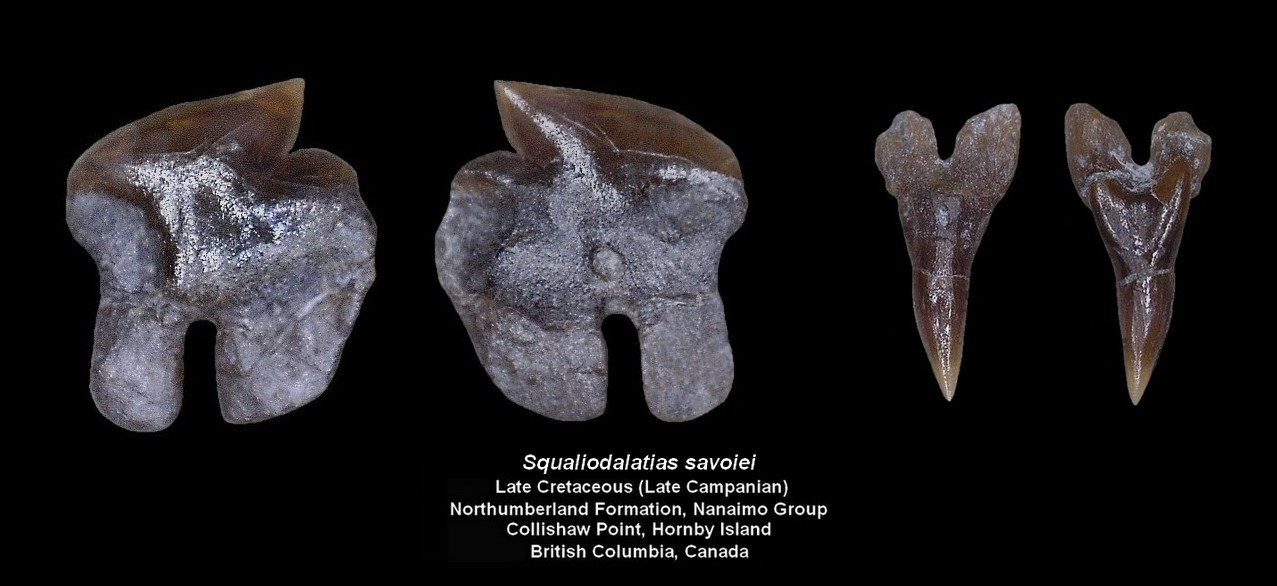
Squaliodalatias savoiei Cappetta, Morrison & Adnet, 2019, Late Cretaceous, Late Campanian, Northumberland Formation, Nanalmo Group, Collishaw Point, Hornby Island, Canada, collection and © Adam Anderson
Squaliodalatias savoiei Cappetta, Morrison & Adnet, 2019, Late Cretaceous, Late Campanian, Northumberland Formation, Nanalmo Group, Collishaw Point, Hornby Island, Canada, collection and © Adam Anderson
Description
Original diagnosis after Cappetta, Morrison & Adnet, 2019 [27810]: Lower teeth strongly labio-lingually flattened, higher than broad in anterior files and broader than high in the lateral files. The cusp is sharp, rather broad and bent distally, with smooth cutting edges. A small distal heel is present with a convex cutting edge. Labially, the limit of the crown is concave, down to the level of the high and narrow notch separating the lobes of the root. Distally, the limit is more oblique and slightly irregular, joining the base of the heel. Labially, the base of the crown overhangs the notch of the root by a bifid and rather flat apron. The mesial limit of the root shows a mesial process followed by a broad concavity joining the mesial limit of the lobe. The limit of the distal lobe, broader than the mesial one, is regularly rounded with a concave sinuosity at the junction of the distal process joining the base of the heel. In lingual view, the limit of the crown is rather straight overall, with a not very marked median convexity corresponding to an uvula. There is a strong lingual protuberance with a central foramen. Mesially, this protuberance projects a sort of spur, and distally, it differentiates a sort of rounded bulb clearly overhanging the disto-lingual articular facet.
In very lateral teeth, the limit of the basal edge of the root is convex, without separation of lobes. The mesial limit draws an angular indentation.
The upper anterior teeth have an erect sharp cusp slightly bent distally. The base of the mesial cutting edge bears an oblique heel not very salient yet quite distinct. In labial view, the outline of the cusp is straight to slightly convex, with the cutting edge restricted to this part. The base of the cusp, devoid of cutting edge, joins a deep to oblique distal heel by a well-marked concavity. There is a bifid apron with diverging branches, the mesial one being narrower than the distal one, and capping the top of a high and narrow axial duct separating the lobes of the root. The outline of the lobes is angular marginally.
Original diagnosis after Cappetta, Morrison & Adnet, 2019 [27810]: Lower teeth strongly labio-lingually flattened, higher than broad in anterior files and broader than high in the lateral files. The cusp is sharp, rather broad and bent distally, with smooth cutting edges. A small distal heel is present with a convex cutting edge. Labially, the limit of the crown is concave, down to the level of the high and narrow notch separating the lobes of the root. Distally, the limit is more oblique and slightly irregular, joining the base of the heel. Labially, the base of the crown overhangs the notch of the root by a bifid and rather flat apron. The mesial limit of the root shows a mesial process followed by a broad concavity joining the mesial limit of the lobe. The limit of the distal lobe, broader than the mesial one, is regularly rounded with a concave sinuosity at the junction of the distal process joining the base of the heel. In lingual view, the limit of the crown is rather straight overall, with a not very marked median convexity corresponding to an uvula. There is a strong lingual protuberance with a central foramen. Mesially, this protuberance projects a sort of spur, and distally, it differentiates a sort of rounded bulb clearly overhanging the disto-lingual articular facet.
In very lateral teeth, the limit of the basal edge of the root is convex, without separation of lobes. The mesial limit draws an angular indentation.
The upper anterior teeth have an erect sharp cusp slightly bent distally. The base of the mesial cutting edge bears an oblique heel not very salient yet quite distinct. In labial view, the outline of the cusp is straight to slightly convex, with the cutting edge restricted to this part. The base of the cusp, devoid of cutting edge, joins a deep to oblique distal heel by a well-marked concavity. There is a bifid apron with diverging branches, the mesial one being narrower than the distal one, and capping the top of a high and narrow axial duct separating the lobes of the root. The outline of the lobes is angular marginally.
References

Bioluminescence and repeated deep-sea colonization shaped the diversification and body size evolution of squaliform sharks. Proceedings of the Royal Society B-Biological Sciences, 292(2042), Article 20242932
DOI: 10.1098/rspb.2024.2932
Global impact and selectivity of the Cretaceous-Paleogene mass extinction among sharks, skates, and rays. Science, 379, 802–806
DOI: 10.1126/science.abn2080
A shark fauna from the Campanian of Hornby Island, British Columbia, Canada: an insight into the diversity of Cretaceous deep-water assemblages. Historical Biology, 33(8), 1121–1182
DOI: 10.1080/08912963.2019.1681421
Bioluminescence and repeated deep-sea colonization shaped the diversification and body size evolution of squaliform sharks. Proceedings of the Royal Society B-Biological Sciences, 292(2042), Article 20242932
DOI: 10.1098/rspb.2024.2932
Global impact and selectivity of the Cretaceous-Paleogene mass extinction among sharks, skates, and rays. Science, 379, 802–806
DOI: 10.1126/science.abn2080
A shark fauna from the Campanian of Hornby Island, British Columbia, Canada: an insight into the diversity of Cretaceous deep-water assemblages. Historical Biology, 33(8), 1121–1182
DOI: 10.1080/08912963.2019.1681421