


 Catalog of Fishes
 literature references
 FishBase
 NCBI GenBank
Tetronarce ramanamurthyi
Bineesh, Kasinath & Ebert, 2026
Classification: Elasmobranchii Torpediniformes Torpedinidae
Reference of the original description
Tetronarce ramanamurthyi sp. nov. (Torpediniformes: Torpedinidae), a new species of electric ray from the southeastern Arabian Sea, northern Indian Ocean. Zootaxa, 5890(4), 557–570
Tetronarce ramanamurthyi sp. nov. (Torpediniformes: Torpedinidae), a new species of electric ray from the southeastern Arabian Sea, northern Indian Ocean. Zootaxa, 5890(4), 557–570
Types
Tetronarce ramanamurthyi
ZSI: MBRC/F/3305; ZSI: MBRC/F/3306; ZSI: MBRC/F/3317; ZSI: MBRC/F/3307; ZSI: MBRC/ F/3312; ZSI: MBRC/F/3313; ZSI: MBRC/ F/3314; ZSI: MBRC/F/3315; ZSI: MBRC/F/3316;
Tetronarce ramanamurthyi
ZSI: MBRC/F/3305; ZSI: MBRC/F/3306; ZSI: MBRC/F/3317; ZSI: MBRC/F/3307; ZSI: MBRC/ F/3312; ZSI: MBRC/F/3313; ZSI: MBRC/ F/3314; ZSI: MBRC/F/3315; ZSI: MBRC/F/3316;
Images of types
Description :
Citation: Tetronarce ramanamurthyi Bineesh, Kasinath & Ebert, 2026: In: Database of modern sharks, rays and chimaeras, www.shark-references.com, World Wide Web electronic publication, Version 10/2026
Please send your images of "Tetronarce ramanamurthyi" to info@shark-references.com
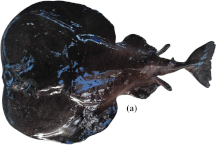
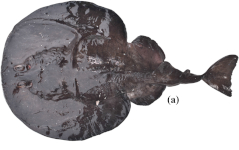
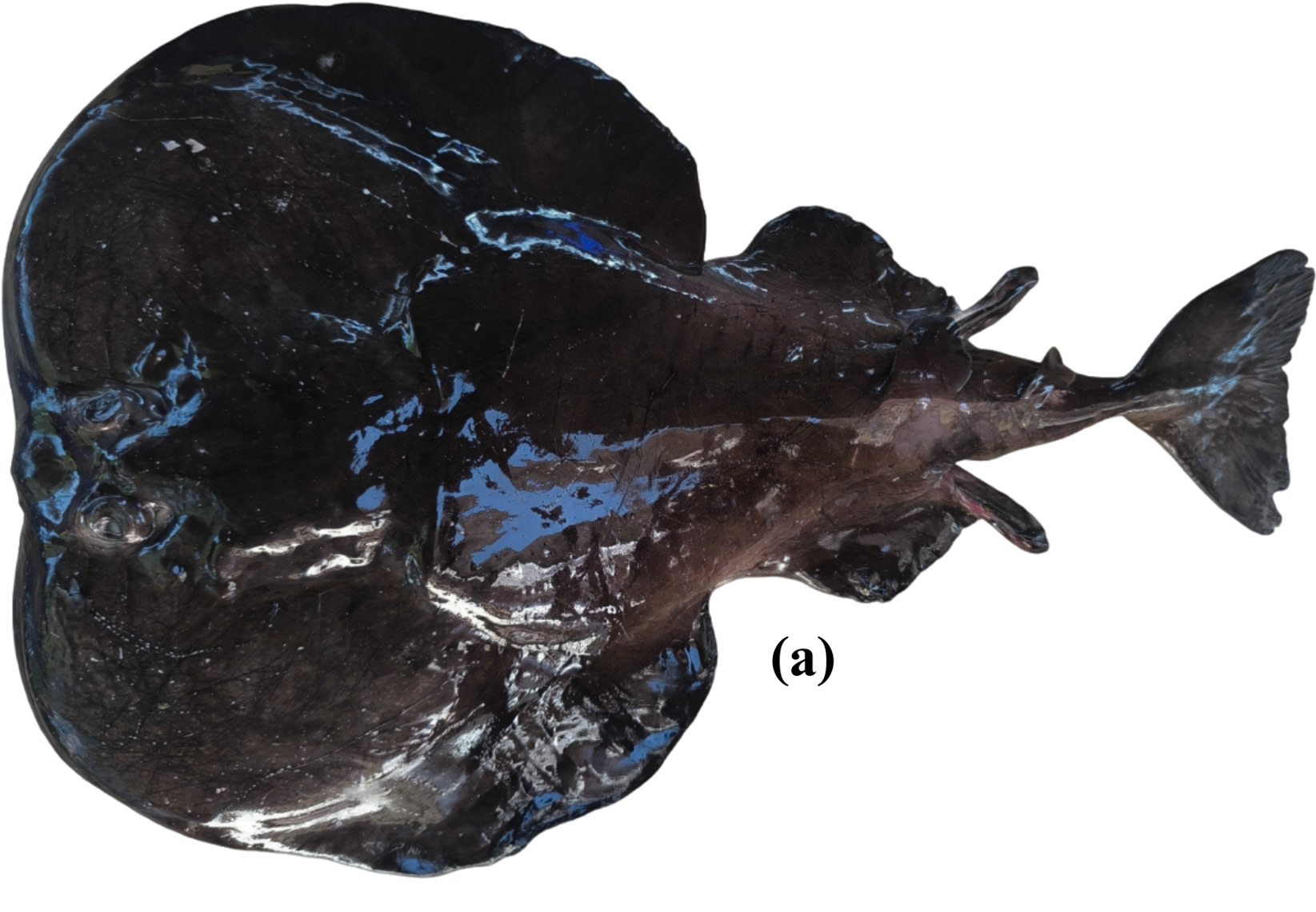
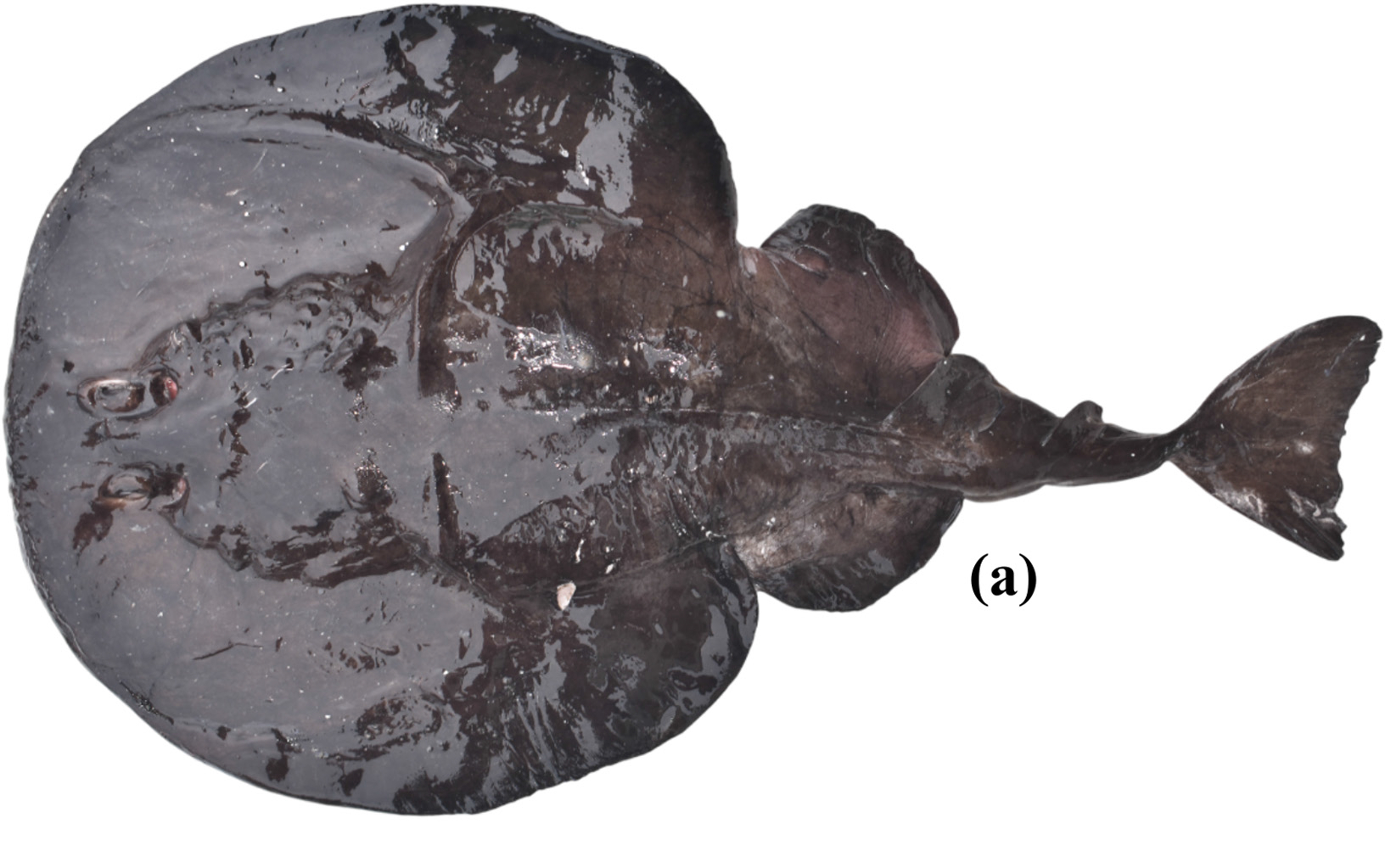
Tetronarce ramanamurthyi Bineesh, Kasinath & Ebert, 2026; ZSI/MBRC/F/3305, mature male, holotype, 525 mm TL © Bineesh, Kasinath & Ebert, 2026
Tetronarce ramanamurthyi Bineesh, Kasinath & Ebert, 2026; ZSI/MBRC/F/3305, mature male, holotype, 525 mm TL © Bineesh, Kasinath & Ebert, 2026
Common names
 Arabian Black Electric Ray
Short Description
Diagnosis after Bineesh, Kasinath & Ebert, 2026 [36414]: A medium-sized species of Tetronarce, reaching a maximum total length (TL) of 771 mm. Dorsal surface uniformly dark bluish black to dark brown, without distinct spots or patterns; ventral surface uniformly whitish, except for darker margins on the pectoral fins, pelvic fins, and tail; distinct black circular patches occasionally present on the ventral surface; papillae around spiracles absent. The species is distinguished from its congeners by the following combination of characters: disc width 64.5 (55.3–65.4)% TL; spiracles relatively large, spiracle length 4.3 (3.9–5.1)% TL; endolymphatic pores relatively large, 1.2 (1.2–1.6)% TL; ventral head length 31.1 (27.4–31.9)% TL; preoral snout length 9.0 (8.1–10.2)% TL; mouth width 2.0 (1.5–2.6) times internarial distance; electric organs relatively small; first dorsal-fin extending beyond pelvic-fin tips; distance between second dorsal and caudal fins 4.2 (4.2–6.7)% TL; caudal fin broadly triangular in both adults and juveniles; clasper length 16.4 (15.3–19.2)% TL. Vertebral count 99, comprising 30 monospondylous and 69 diplospondylous vertebrae. Predorsal vertebrae 42, precaudal vertebrae 75, caudal vertebrae 24, and 33 vertebrae between the origins of the first dorsal and caudal fins. Tooth rows 27 (27–28) in the upper jaw and 28 (26–28) in the lower jaw.
Diagnosis after Bineesh, Kasinath & Ebert, 2026 [36414]: A medium-sized species of Tetronarce, reaching a maximum total length (TL) of 771 mm. Dorsal surface uniformly dark bluish black to dark brown, without distinct spots or patterns; ventral surface uniformly whitish, except for darker margins on the pectoral fins, pelvic fins, and tail; distinct black circular patches occasionally present on the ventral surface; papillae around spiracles absent. The species is distinguished from its congeners by the following combination of characters: disc width 64.5 (55.3–65.4)% TL; spiracles relatively large, spiracle length 4.3 (3.9–5.1)% TL; endolymphatic pores relatively large, 1.2 (1.2–1.6)% TL; ventral head length 31.1 (27.4–31.9)% TL; preoral snout length 9.0 (8.1–10.2)% TL; mouth width 2.0 (1.5–2.6) times internarial distance; electric organs relatively small; first dorsal-fin extending beyond pelvic-fin tips; distance between second dorsal and caudal fins 4.2 (4.2–6.7)% TL; caudal fin broadly triangular in both adults and juveniles; clasper length 16.4 (15.3–19.2)% TL. Vertebral count 99, comprising 30 monospondylous and 69 diplospondylous vertebrae. Predorsal vertebrae 42, precaudal vertebrae 75, caudal vertebrae 24, and 33 vertebrae between the origins of the first dorsal and caudal fins. Tooth rows 27 (27–28) in the upper jaw and 28 (26–28) in the lower jaw.
Remarks
shark-references Species-ID=17947
shark-references Species-ID=17947